

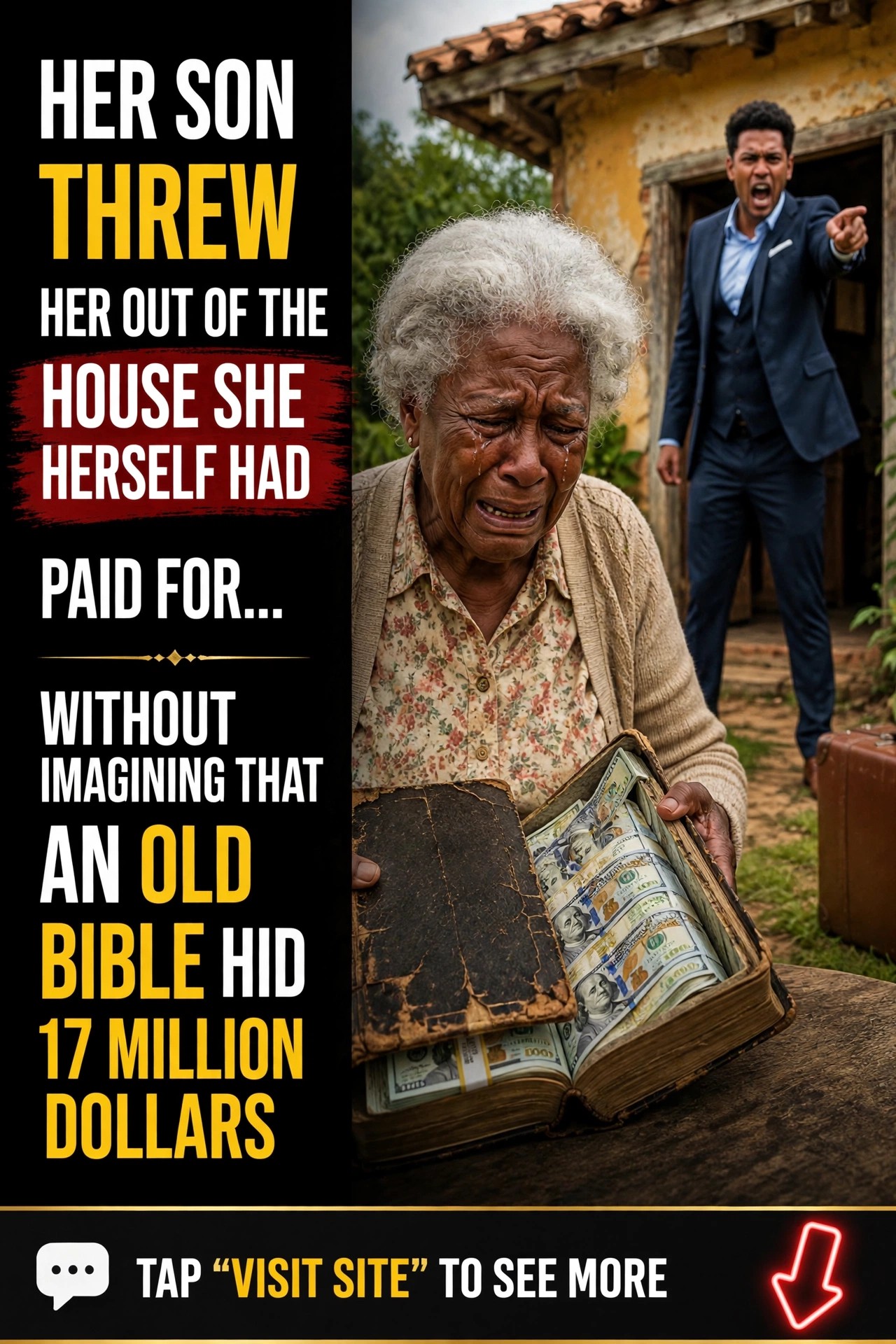
The house had been Doña Margarita’s in everything but the signature. She had paid for it brick by brick with forty years of sewing — wedding dresses for half the town, christening gowns for the other half — but when her husband died, the deed had passed, by old custom, to her only son, Fabián. «A son is a mother’s roof,» she used to say. She stopped saying it the afternoon Fabián, encouraged by a wife who called the old woman «a burden with opinions,» stood in the doorway of that house in his good suit, pointed at the street, and shouted the sentence the neighbors would never forget: «This is my house now. Pack your things and go.» Margarita, seventy-nine years old, packed one suitcase: two dresses, her sewing needles, a photograph of her wedding — and her husband’s old Bible, its cover cracked, its spine held together with thread, the book he had read to her every night.
She was sitting on the porch with her suitcase when she noticed it. The Bible was heavy. It had always been heavy with meaning, but this was different — this was weight. With trembling hands she opened it on her lap, and the pages did not open: the book was hollow, carved out inside like a secret drawer, and packed tight, bundle upon bundle, with banknotes. Seventeen million dollars, the bank would count later — and on the first hollowed page, in her husband’s careful handwriting, a letter: «Margarita: coin by coin, harvest by harvest, I saved this where no one would think to look — inside the Word we read together. If you are reading it, I am gone. It is yours. It was always yours. Live the years they owe you, my love.»
Her husband had known. That was what undid her, there on the porch of the house she was being thrown out of: for fifty years, Aurelio had quietly converted his earnings into dollars and hidden them in the book his wife held every day — because he had seen, long before she could, what their son might become. Margarita closed the Bible, dried her eyes, and did something that stunned the neighbors even more than the shouting had. She did not call the police. She did not scream. She simply stood, suitcase in one hand and Bible in the other, and walked away with a straight back, while her son watched from the door of «his» house, not knowing he had just pointed his own fortune out into the street.
A month later, Margarita bought a beautiful house two streets away — her name, alone, on the deed — with a garden, a sewing room full of light, and a cook who called her «Doña.» Fabián found out the way the whole town did: all at once, and too late. He came to her new door with flowers and a speech about misunderstandings. His mother received him kindly, served him coffee, and listened to every word. Then she said: «The house you threw me out of is yours, Fabián. Keep it. But understand what you threw out with me — not an old woman. Your father’s blessing. He left it in my Bible, in my hands, because he knew whose they were.» He visits her now on Sundays, quieter, humbler, learning at last — and she receives him, because a mother’s heart is stubborn. But the new house has one rule, carved on a wooden sign by the door, in letters her husband would have loved: «Here, no one is a burden.»