

The doctors had been kind, and unanimous, and wrong. After the accident that took their mother and shattered their legs, the Serrano twins — Mateo and Lucas, nineteen — would «most likely» never walk again, and their father, the millionaire Ernesto Serrano, had done what money does: he had accepted the verdict expensively. A house adapted in marble, the best wheelchairs, nurses in rotation — everything except the one thing money had stopped believing in: effort. The twins spent their days in the great salon, educated, entertained, and still. Into that stillness, a year ago, had come Rosa: the new maid, thirty-five, unremarkable on paper, who cleaned the salon every morning and talked to the boys while she worked — not about their chairs, but about everything else, as if the chairs were furniture and not fate.
What Ernesto did not know was how Rosa spent her afternoons. Her wages, which she could not spare, went partly to a retired physiotherapist in her neighborhood, who taught her, session by session, the exercises of rehabilitation: how to strengthen what the accident had left, and how to hold a young man’s weight without stealing his dignity. And every day, when the salon emptied, Rosa knelt on the carpet before the two wheelchairs and ran her secret clinic: «One step is all I ask today, señores. Tomorrow we negotiate the second.» The boys, who adored her, worked like athletes. For eleven months. In secret, because Rosa feared dismissal, and the twins feared their father’s hope almost as much as his despair.
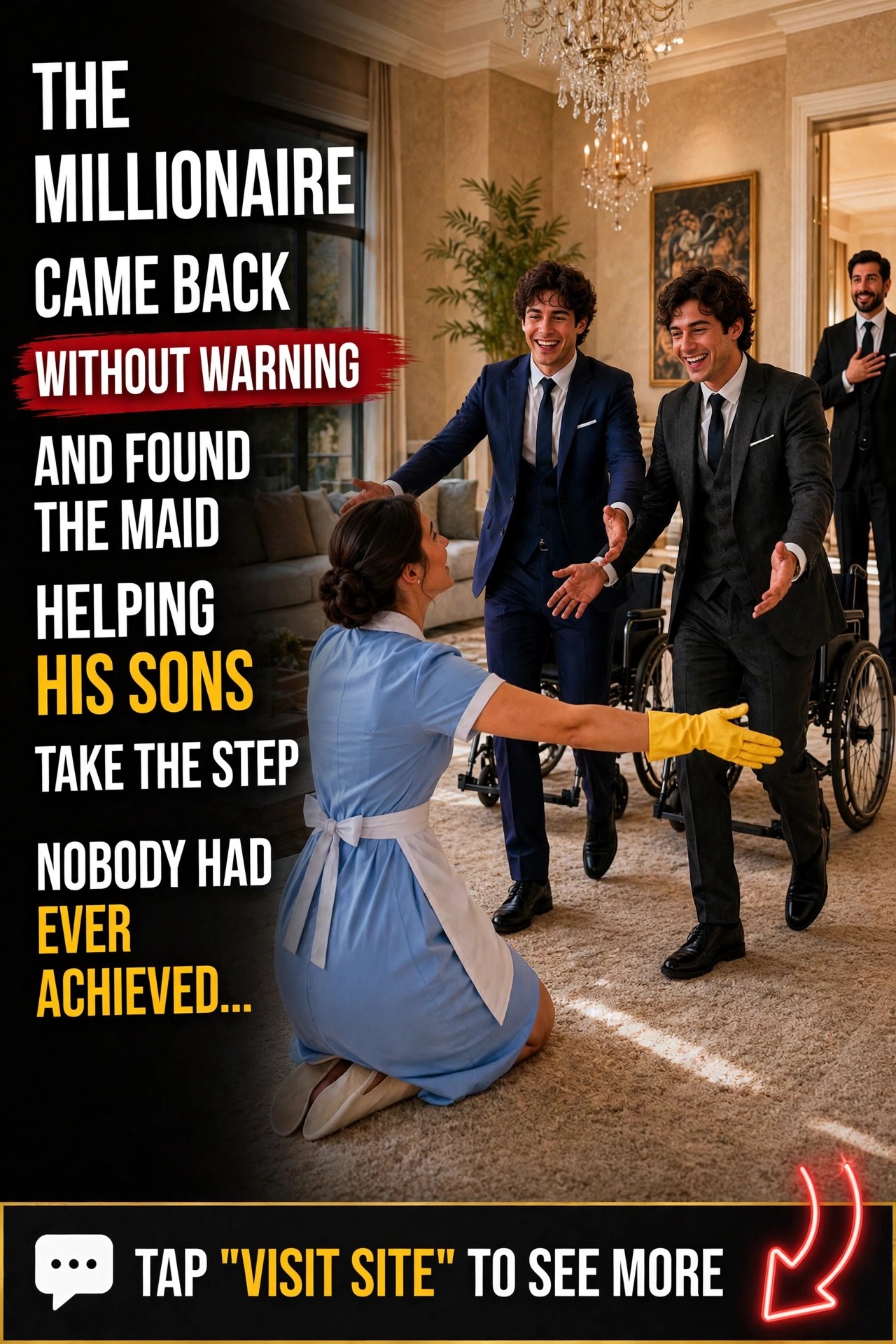
Ernesto came home that Tuesday unannounced, three hours early, and stopped in the doorway of his own salon with his briefcase in his hand. Rosa was on her knees on the carpet, arms raised, yellow cleaning gloves still on her hands, her face lit like a woman watching a sunrise — and his sons were standing. Standing. Mateo first, gripping the chair’s arms, swaying, grinning through tears; then Lucas, rising on legs that shook like saplings, the two of them taking one step, and then another, into the arms of their maid, who caught them laughing and crying at once: «¡Eso! ¡Eso es! Who told you you couldn’t? Nobody who knows you, that’s who!» Ernesto’s briefcase hit the floor. The sound made them turn, and for one frozen second Rosa’s face filled with terror — until the millionaire of the house crossed his own salon, took her yellow-gloved hands in both of his, and could not speak at all.
What he did when he could speak, the family still calls «the Rosa settlement,» and it was not a bonus. He funded the twins’ complete rehabilitation — the finest clinic in the country, the retired physiotherapist hired on staff — with Rosa installed as director of the only department that mattered: morale. He paid her back every cent of her wages spent on lessons, with interest he calculated himself. And when, two years later, Mateo and Lucas walked — walked — across a stage to receive their university degrees, they stopped at the edge of the steps, turned to the third row, and bowed to a woman in a new blue dress, who cried into her hands. Ernesto, applauding beside her, said the line the newspapers printed: «I hired a maid. God had sent a physiotherapist of the soul. She charged me nothing — she was too busy paying for my sons’ future out of a maid’s wages. Everything I own was never worth one of her afternoons.»