

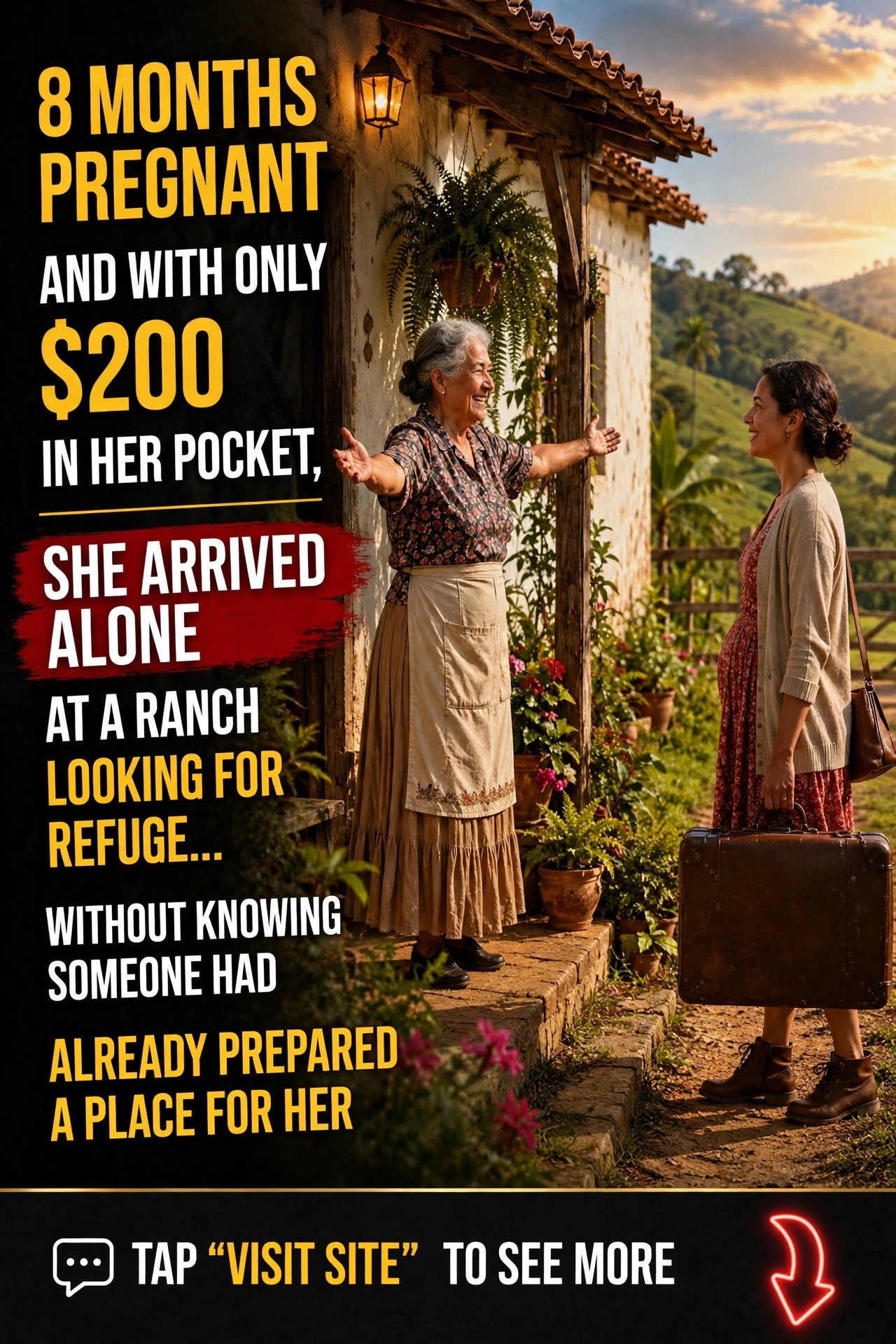
When the bus left her at the crossroads with one suitcase and two hundred dollars folded inside her blouse, Marisol did the arithmetic of the desperate: eight months pregnant, a boyfriend who had vanished at the news, parents who had closed their door in shame, and a single address, half-remembered from childhood stories — a ranch in the hills where her late mother had once worked a summer, forty years ago, for a woman her mother had called «my sister of the heart.» Marisol did not know if the woman was alive. She did not know if the ranch existed. She walked the four miles anyway, because walking toward something, however unlikely, is better than standing still inside nothing. At the gate, an old woman with silver hair and an apron full of garden flowers was already standing — as if she had heard the footsteps a mile away, as if she had been standing at that gate, in some way, for a very long time.
«I’m sorry, señora,» Marisol began, with the speech she had rehearsed to a dozen closed doors. «I have nowhere to go. I can work, I can—» She never finished it. Because the old woman, Doña Esperanza, had gone white, and then radiant, and had opened her arms and her gate at the same time, and was crying and laughing into Marisol’s hair like someone receiving the mail forty years late. «You have your mother’s face,» she said. «Word for word her face. Child — I have been waiting for you since before you were born. Come and see your room.»
The room existed. That is the part of the story the town has never stopped telling. Upstairs in the ranch house, with a window over the garden, stood a room kept ready for years: a bed with clean embroidered sheets, a cradle — the cradle of Esperanza’s own long-grown children, repainted white — a rocking chair, and on the dresser, a photograph of two young women laughing in that same garden, one of them unmistakably Marisol’s mother. Forty years earlier, two servant girls had made a promise over that garden fence, the way the young make promises, absolutely: «If life ever separates us, and you or yours ever need a roof — my door. No questions. Forever.» Marisol’s mother had died with the address on her lips, her daughter’s last gift. Esperanza had kept the promise the only way you can keep a promise to the dead: by preparing, every year, a room for a guest she could not name — refreshing the sheets each spring, repainting the cradle twice — «because a promise,» she told the neighbors who called it madness, «is not less of a promise because the other one can’t remind you.»
Marisol’s daughter was born in that room, in the bed with the embroidered sheets, with Esperanza holding her hand and the whole ranch holding its breath — and the old woman, who had no grandchildren, received the baby with the expertise of forty years of waiting. «She arrived with two hundred dollars,» Esperanza liked to say at the christening, beaming, «and she thinks she was poor. She brought me a granddaughter. Richest guest this house ever had.» Marisol stayed, and works the ranch now as its manager and its heir in everything but paperwork — and the paperwork, Esperanza fixed too. The upstairs room is never empty anymore. But its door still carries, in the old woman’s handwriting, the sign she hung there decades before Marisol knocked: «For whoever comes home.»