

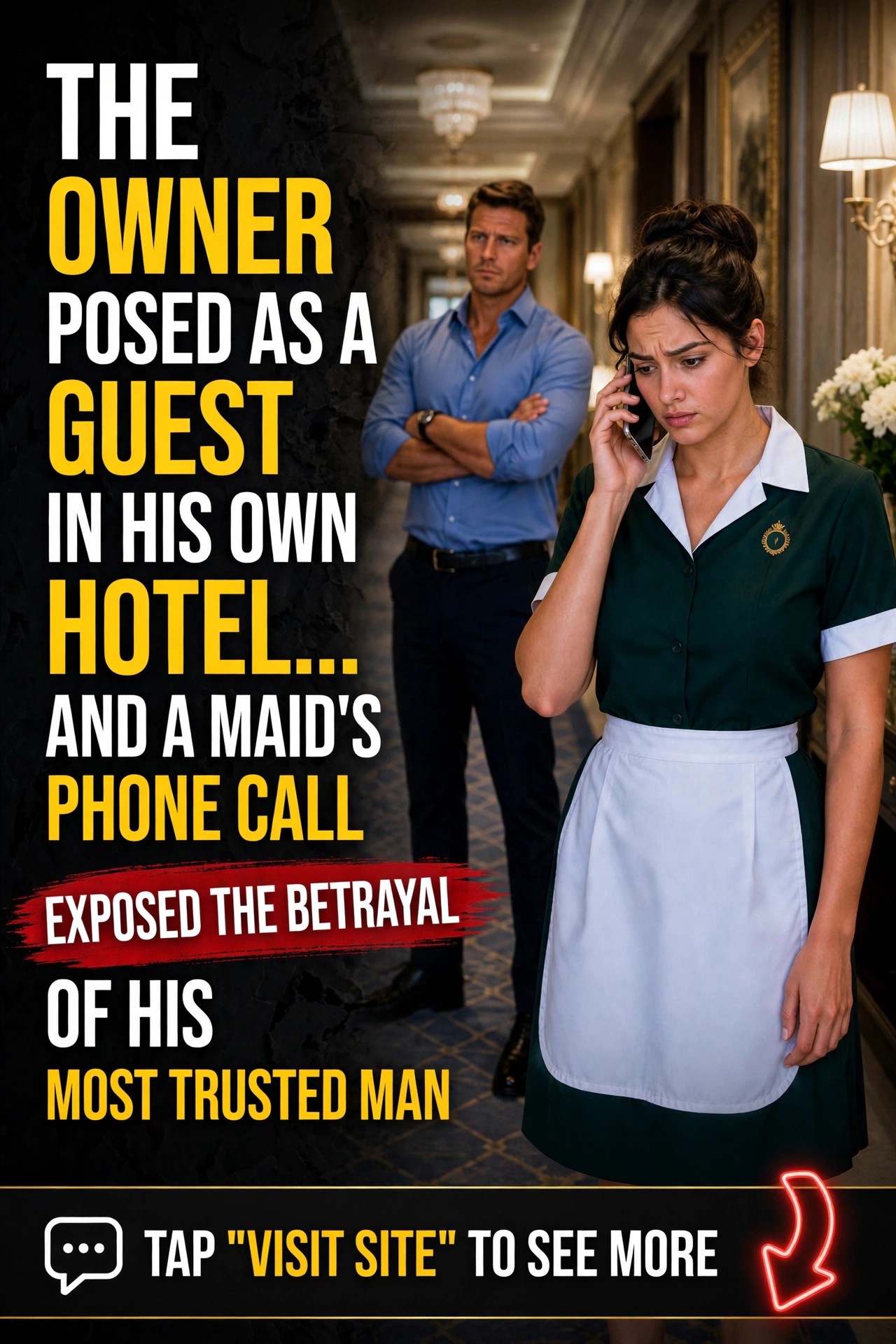
Aurelio Vidal owned the Hotel Mirador for thirty years and had not slept in it once — until the numbers stopped making sense. Occupancy was high, the reviews glowed, yet the profits thinned year after year like soup stretched with water, and his manager of a decade, the impeccable Ricardo Sanz, always had an explanation for everything. So Aurelio did what his grandfather, the hotel’s founder, had advised in a letter kept all his life — «When you stop trusting the reports, go and be a guest» — and checked in on a Tuesday under his mother’s surname, in a false beard, as a traveling salesman. He took a third-floor room and began to be disappointed: cold soup, a leaking tap, housekeeping that existed mainly on paper. What he had not expected was to find the truth in a frightened whisper from the service corridor.
The whisper belonged to Carmen, a chambermaid of twenty-six, four years in the hotel, on the phone with her mother, crying as quietly as she could: «They’re going to fire me Friday, Mamá. Señor Sanz says jewelry disappeared from room 412 and I was the only one who entered. I swear I never saw any jewelry. He told me if I sign a paper saying I took it, he won’t call the police — just dismissal, no scandal. If I sign I can never work again, Mamá, and if I don’t, he’ll ruin me anyway. I don’t know what to do.» Aurelio, in his false beard, understood two things at once: the girl was innocent — no thief rehearses that kind of terror to her mother — and his manager’s polished explanations suddenly smelled.
He knew truth, like a good soufflé, collapses if you open the door too early. Instead, the «guest» became a detective. He befriended the night porter, the accountant’s assistant, the laundry staff — and the pattern surfaced like a body in a lake. For years, Sanz had run an elegant theft: cash bookings recorded as cancellations, supplier invoices doubled, and periodic «guest thefts» blamed on disposable staff, covering the money walking out the door. Carmen was not the first maid offered the paper to sign. She was the fourth. The previous three had signed, and vanished, and their «confessions» sat in Sanz’s drawer like a shield.
On Friday, Sanz summoned Carmen to his office to sign — and found, seated in the guest chair, a traveling salesman removing a false beard. The police, invited by the owner, took Sanz’s statement there; the drawer of confessions, the doubled invoices, and a second set of books found in his car did the rest, and the three maids who had signed before Carmen received formal apologies, back pay, and offers of their jobs back — two accepted, to general celebration. Carmen did not go back to the third floor. Aurelio, who had watched her refuse to sign away her name, made her the hotel’s new head of housekeeping, with a salary that made her cry with joy, and one condition he stated in front of the whole staff: «In this house, we never again make the powerless sign papers. We ask them what happened — and we listen.» The hotel’s profits recovered within the year. Aurelio knew why. He kept Carmen’s unsigned confession in a frame in his office — blank, refused, magnificent — beneath his grandfather’s letter, where it belongs: proof that a hotel is saved not by its marble, but by the honesty of the people who clean its halls.