

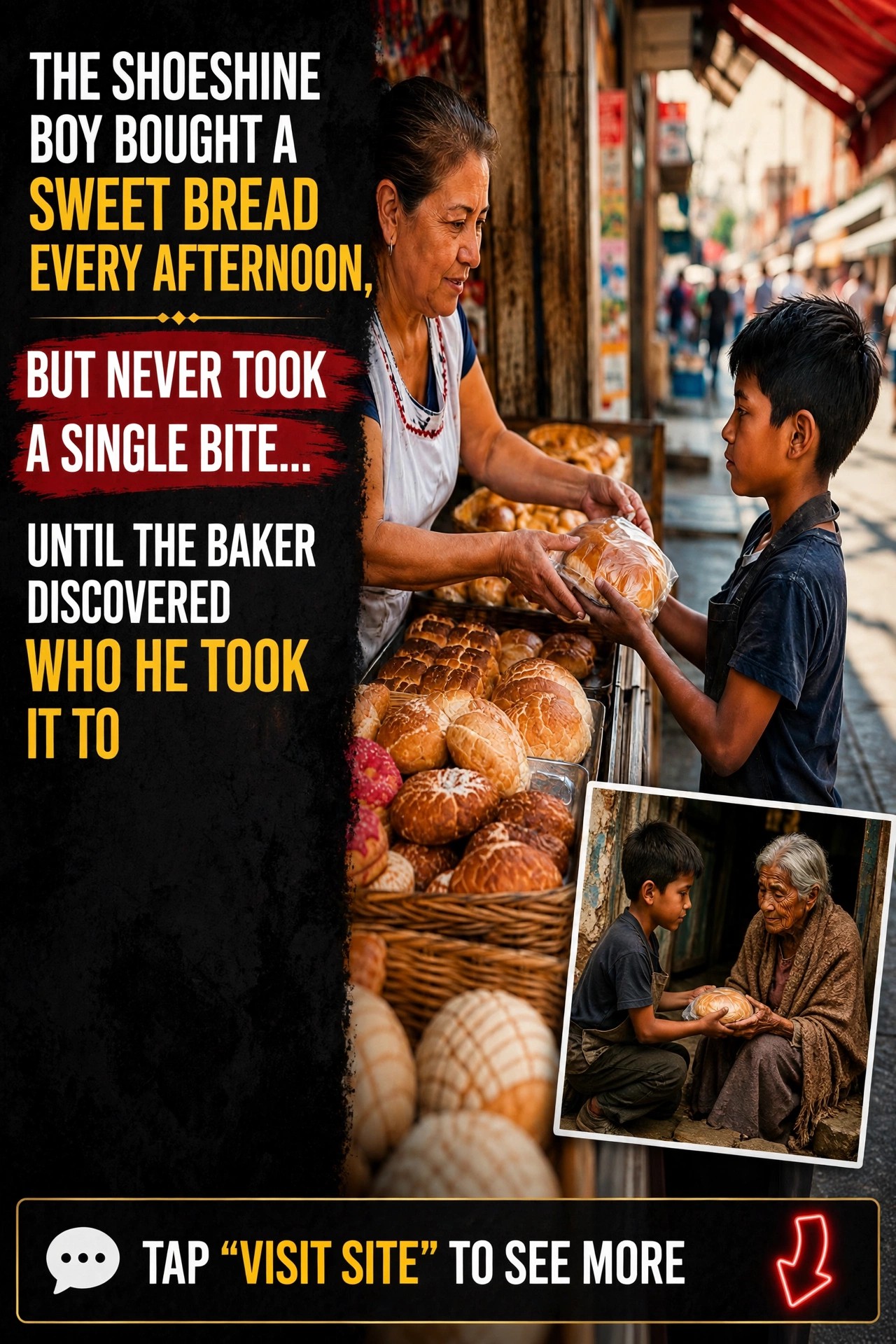
Doña Petra, who had run the little bakery on the market street for thirty years, noticed everything — and for two months she had been noticing the boy. He was nine, maybe ten, a shoeshine boy with a wooden box bigger than his courage, and every afternoon at six he appeared at her counter with his coins counted out exactly: the price of one concha, the sweet bread with the sugar shell. He always chose the freshest one, asked for it in a bag «so it doesn’t get squashed,» and walked out holding it with both hands like something made of glass. But in two months, Petra had never — not once — seen him take a bite. A boy that thin, with bread that warm, and never a bite. That afternoon, something in her chest would not let it rest. She told her niece to watch the shop, untied her apron, and followed him.
He did not go to the plaza. He did not go to the other boys. He walked six blocks to the oldest part of town, to a room behind a rusted gate, and Petra, standing in the shadows of the doorway, finally understood where the conchas went. On a bed by the window sat an old woman — eighty, perhaps more — with clouded, sightless eyes and hair like cotton, and the boy knelt beside her and placed the warm bread in her hands the way you place an offering. «It’s still warm, Abuela,» he said. «Smell it. Today’s has extra sugar.» The old woman’s face lit up like a window at dawn. She broke the bread in two and tried, as she surely tried every day, to give him the bigger half — and he, as every day, lied like a little gentleman: «I already ate mine at the bakery, Abuela. That one’s all yours.»
Petra cried all the way back to her shop. The boy was Diego; the old woman was his grandmother Carmen, blind since before he was born, who had raised him alone after his mother died and now could no longer leave her bed. The child shined shoes from sunrise, paid the rent of that room coin by coin, and spent his last money each day not on himself — he had not tasted it once in two months — but on the one warm, sweet thing that made his grandmother smile. That evening, when Diego appeared at six with his counted coins, Petra put two conchas in the bag, then a loaf, cheese and milk, and when he tried to pay she closed his fist over his money. «From today, your money is no good here,» she said, in the gruff voice she used for hiding her heart. «And tomorrow you come at five, not six. I need someone strong to help me close the shop. The pay is dinner — for you AND for a certain lady who likes her bread warm.»
Diego worked for Petra for six years, growing straight and strong on bakery dinners. Doña Carmen lived to ninety-one, and to her last day she insisted that her grandson’s bread was the best in the world — never knowing it came free, because Petra had sworn his secret was safe. And when Petra’s own portrait went up in the bakery years later, it was Diego — by then the shop’s master baker — who hung beneath it a small wooden sign with the words she had taught him without ever saying them: «Bread tastes better when it’s for someone else.»