

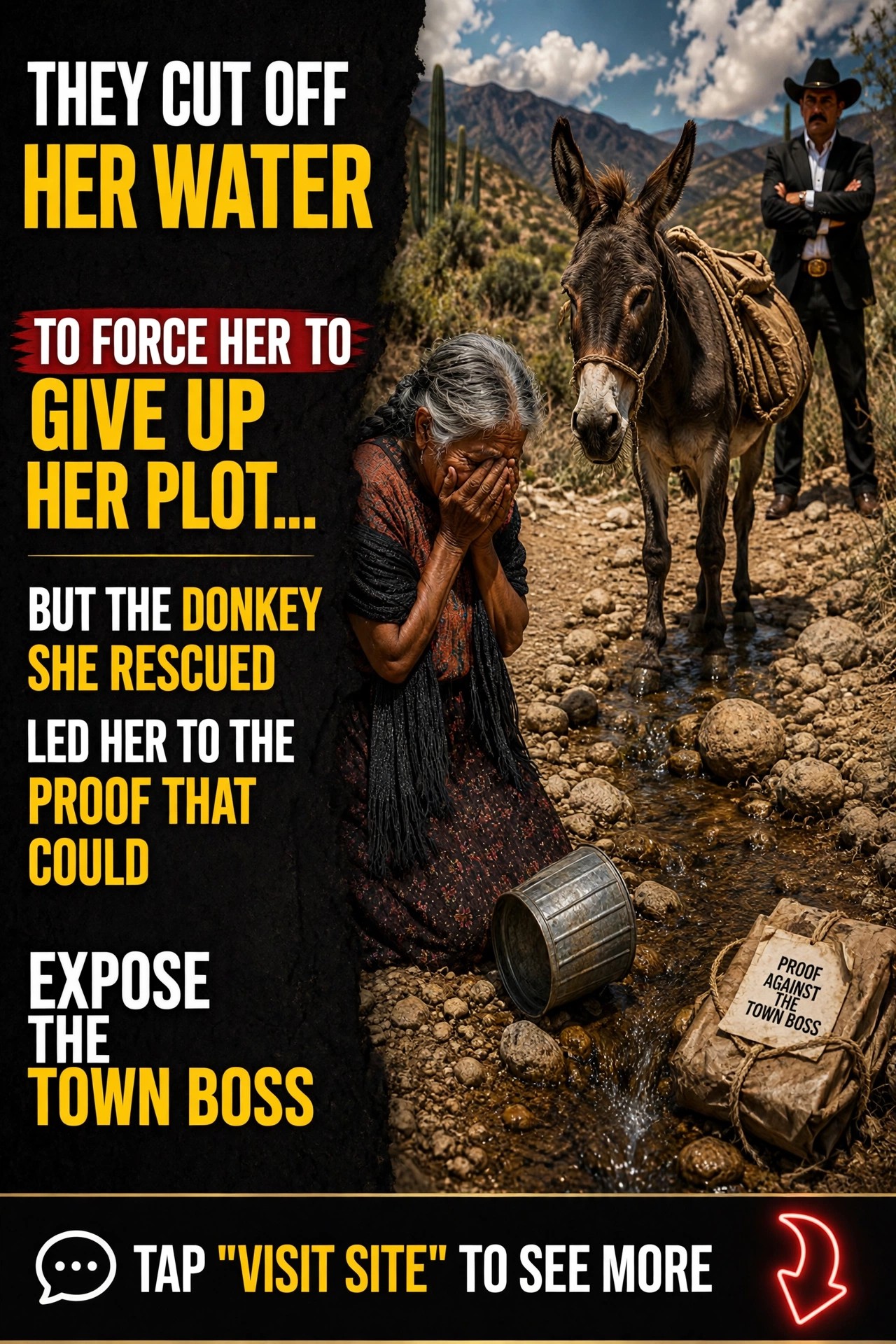
Everyone in the valley knew why Don Silvestre, the town boss, wanted the widow Brígida’s little plot: it sat exactly where his new irrigation canal needed to pass, and Brígida — seventy-four, alone, stubborn as the stones in her field — was the only owner who had refused his money. So Silvestre stopped offering money. First her fence was cut in the night. Then the communal water board, which answered to him, discovered «irregularities» in her papers, and one morning Brígida turned her tap and heard the dry rattle of an empty pipe. No water for her house, no water for her plot, in the hottest month of the year. «Sell, old woman,» Silvestre told her in the plaza, smiling for the witnesses, «or dry up with your land.» She carried buckets from the creek for eleven days, on foot, under the sun, and did not sell.
The creek was where the other half of this story begins — because Brígida was not the only one Silvestre’s world had tried to break. Years earlier she had found a donkey half-dead by the road, beaten and abandoned by a muleteer, and had nursed him back with her own hands and her own scarce water, naming him Testarudo — Stubborn — «because he is like me.» Testarudo knew every path she had ever walked, and on the eleventh day, when Brígida knelt by the shrinking creek with her bucket and wept from exhaustion, the donkey did something strange: he pulled at the bucket’s rope and walked upstream, into the dry upper bed where the water had not run in years, stopping again and again to look back at her — until he stopped entirely at a bend, beside a flat stone, and began to paw the ground.
Brígida dug where he pawed, first with a stick, then with her hands, and her fingers found oilcloth. Inside the buried bundle, wrapped against the damp for years, were documents: survey maps with altered boundaries, receipts signed by dead men, a ledger in a careful hand listing plot after plot — the whole hidden machinery of how Silvestre had stolen land across the valley, buried, everyone later understood, by his own frightened surveyor as insurance against his boss. Brígida could not read well. But she knew exactly what she was holding, because her late husband’s name was on the third page, beside a plot she had always believed he had sold — and never had.
She did not confront Silvestre. She rode Testarudo to the district capital, bundle in her saddlebag, and laid twenty years of theft on a prosecutor’s desk. The investigation emptied the town hall; the water board was dissolved; Silvestre, who had cut off an old woman’s water, ended his days answering to judges in the city, and six families recovered land they had mourned for decades. Brígida’s tap ran again within the week — but by then she had done something the valley still talks about: she opened her plot’s well to every neighbor whose water Silvestre had ever touched, free, forever. And Testarudo, hero of the valley, grew fat and ancient in her yard, with a brass bell and a shade tree of his own — because Brígida told everyone the same truth: «I rescued him once, with a bucket of water. He repaid me with a river.»