

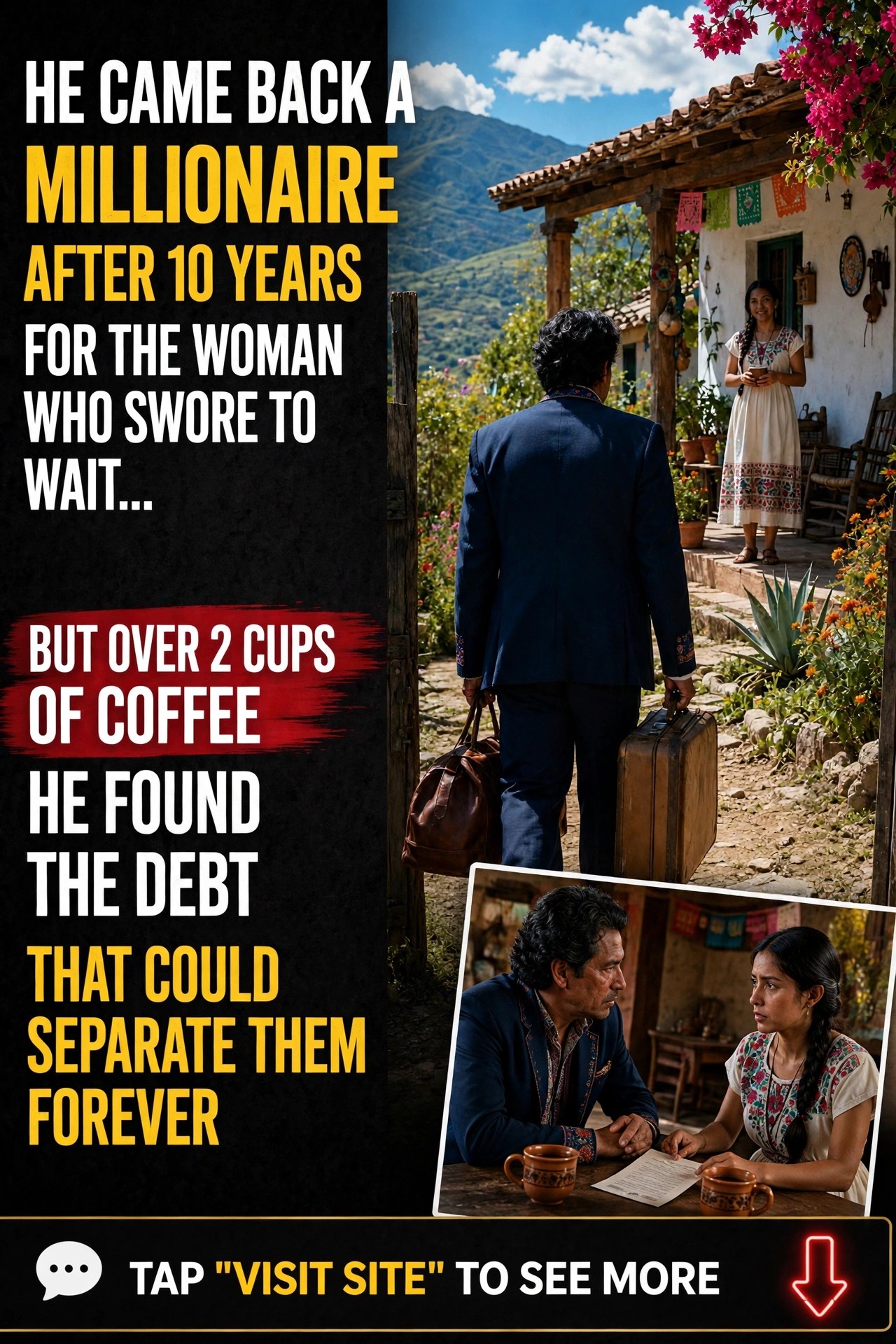
Ten years ago, Martín Aguilar left his village with a cardboard suitcase, forty dollars, and a promise made under the bougainvillea at Isabel’s gate: «Wait for me. I will come back with enough to give you the life you deserve.» He kept his word the hard way — a decade of construction sites, night shifts, and winters in a country whose language he learned from foremen and loneliness. He sent money when he could, wrote letters every Sunday, and built, brick by brick, a company of his own. When his plane finally landed, Martín was a millionaire, and the first road he drove was the one back to her gate.
Isabel was waiting on the porch, in the white embroidered dress, older and more beautiful than his memory had dared to keep her. She had waited. That was the miracle he held onto as they sat at her kitchen table, two clay cups of coffee between them, laughing like the twenty-year-olds they had been. Then Isabel’s smile faded. From beneath a cloth she took out a folder and slid it across the table. «Before you ask me anything,» she said, «you have to see this. I was going to hide it. But love built on a hiding place doesn’t last.»
The document was a bank notice: a debt of nearly two hundred thousand dollars, in Martín’s name. His father, before dying, had signed loans using the family land as guarantee — and when the land was about to be seized, Isabel, without writing a word of it in ten years of letters, had taken over the payments herself. She had worked three jobs. She had sold her mother’s jewelry, piece by piece. The debt that remained was the last of it, and the bank’s final notice had arrived the same week as Martín. «I didn’t wait for you to be rescued,» she said, steady and proud. «I waited because I love you. But I won’t marry you with a chain around your name that you don’t know about.»
Martín read the notice twice. Then he closed the folder, took her work-worn hands across the table, and said the sentence she would repeat at their wedding: «You carried my family’s debt for ten years so I could come home free. Isabel — I didn’t cross an ocean to buy a life. I crossed it to share one. The debt is ours now, and it is the smallest thing I will ever pay, because you already paid the biggest part: the waiting.» He settled the debt that month, all of it, and refused to let her sell the last ring she had left. They were married under the same bougainvillea, and on the kitchen table, framed, there are still two clay cups — a reminder that true wealth is not what a man brings home in his accounts, but what a woman kept safe in his absence: his name, his honor, and his home.