

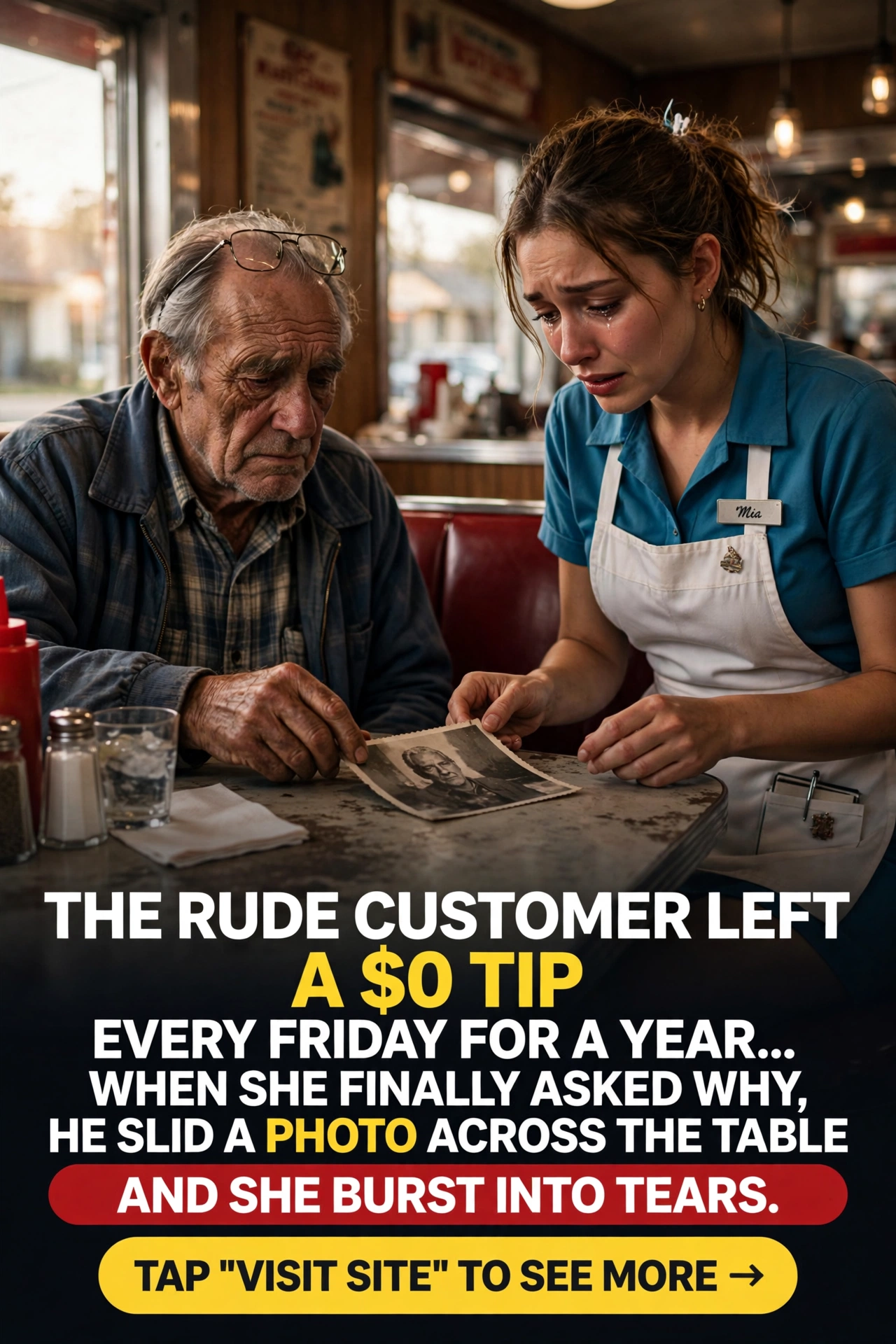
Every diner has one, and at the Starlite Diner on Route 9, his name was Walter Briggs. Seventy-nine years old, same booth every Friday at noon — table six, by the window — same order, same complaints. The coffee was too weak. The eggs were too slow. The music was too loud. And when the check came, Walter paid it to the cent, stood up, put on his coat, and left exactly zero dollars on the table. Every Friday. For a year.
The other waitresses refused his section. Mia — twenty-six, saving for nursing school, too stubborn to give up on anybody — took him every week. She learned to bring the coffee strong enough to strip paint and the check before he asked. The tip line stayed empty, and her coworkers started calling table six «the charity booth.»
What none of them knew was that Mia had a rule: you never ask a customer about the tip. But rules bend, and on a gray Friday in November — a year to the day since his first visit — Walter was quieter than usual, staring out the window at the rain, turning his wedding ring around his finger. She set down his pie and heard herself ask, gently: «Walter… is it something I do? A whole year, and I can’t figure out what I’m doing wrong.»
Walter looked at her for a long moment. Then he reached into his coat, took out his wallet, and from a sleeve behind the bills he drew a faded photograph, which he slid across the table without a word.
It showed a young woman in a Starlite Diner uniform — this diner, this uniform — standing at table six with a coffee pot, laughing at something off-camera. On the back, in pencil: Rose, Friday, 1979. Our table.
«My wife,» Walter said. «She worked this booth for six years. I sat right here every Friday of 1979 working up the nerve to ask her out. Took me forty-one Fridays.» His voice cracked. «She died last November. A year ago Friday. I come because this is where she is. And the tip—» He stopped, embarrassed, and pushed a worn bank book across the table too. «Rose always said tips were for the girls saving for something. So I’ve been putting it in there. Every Friday. It’s under your name, Mia. There’s… a bit over four thousand dollars. For the nursing school.»
Mia burst into tears — standing at table six, in front of the whole lunch crowd, holding a photograph of a laughing girl in her own uniform. Because there was one more thing about the photograph: the young woman’s face. The dark hair, the stubborn chin, the exact tilt of the smile. Mia had seen that face every morning of her life — in her mother’s wedding album. Rose Briggs, née Rose Callahan, was her grandmother’s younger sister. Her great-aunt. Which made the gruff old man at table six family — the great-uncle her branch of the family had lost track of after a funeral argument thirty years ago, before Mia was even born.
Walter had recognized her the first Friday he walked in. He’d been coming back, week after week, to sit near the last living piece of Rose — too proud, and too afraid of rejection, to say a word.
These days, table six at the Starlite is reserved on Fridays at noon. Walter still complains about the coffee. But now he does it at Mia’s mother’s Sunday table too, where he is, officially and forever, family — and where nobody, absolutely nobody, lets him pay for anything.