

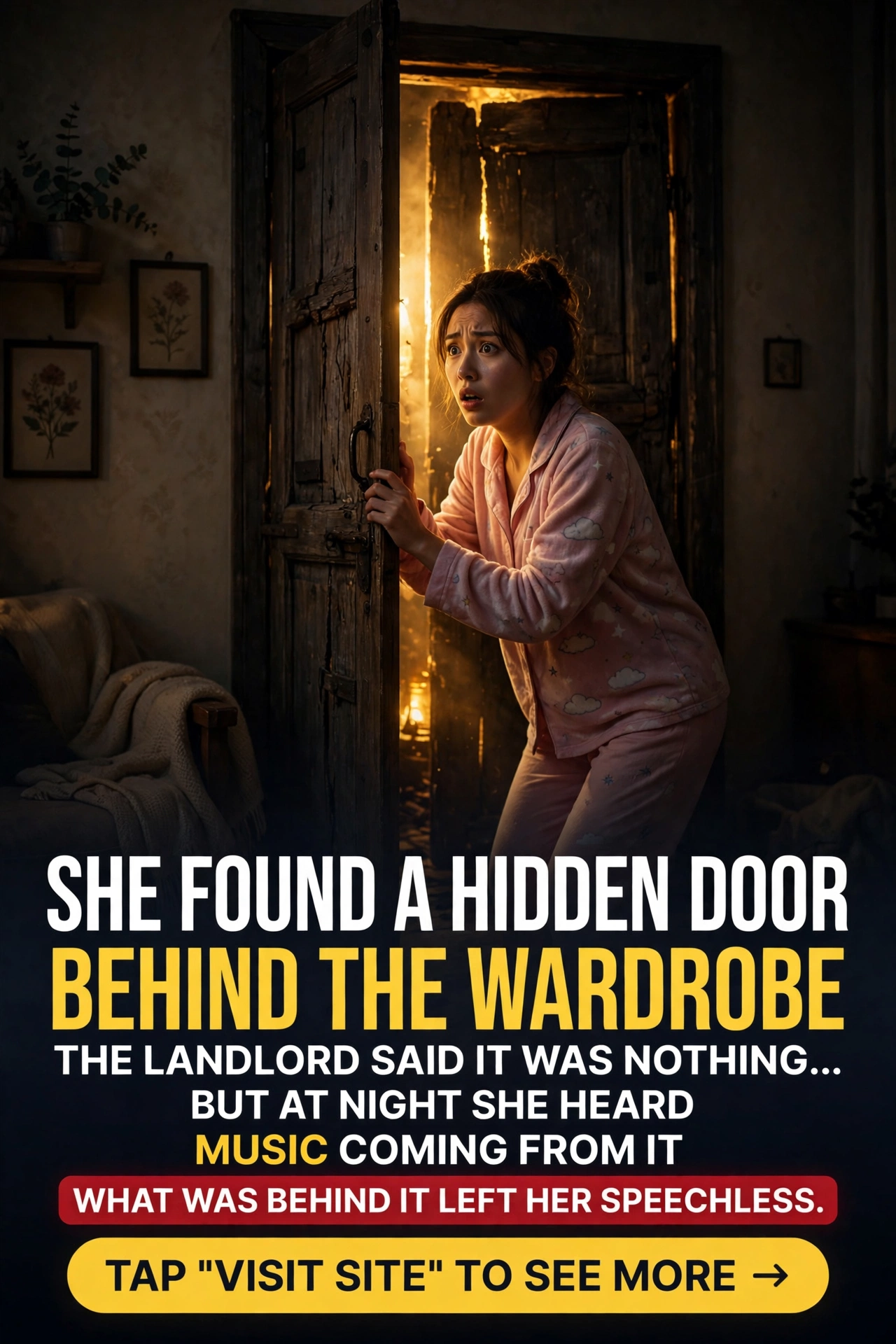
Clara Bennett found the door on her second day in the apartment, while pushing the heavy wardrobe against the bedroom wall. The wardrobe scraped, shifted — and revealed a doorframe where there should have been plaster. The door itself was old oak, painted over so many times its handle was a smooth lump of white. On every floor plan of the building, Clara’s bedroom wall was the end of the world.
Mr. Novak, her landlord — eighty-one years old, living alone in the apartment below — went very still when she asked about it. «Old storage,» he said at last. «Sealed before you were born. It is nothing. Please — leave it.» The rent, Clara reminded herself, was four hundred dollars below market. She left it.
For eleven nights, she left it. On the twelfth, the music started.
It came at 11:40 p.m., so faint she thought it was a neighbor’s radio: a piano, playing something slow and aching and unmistakably live — a recording doesn’t hesitate, doesn’t stumble on the hard parts and go back. It played for exactly twenty minutes and stopped. The next night, the same. And the next. Clara lay awake, following it.
On the twentieth night, she got up, pressed her ear to the painted door — and heard, under the piano, an old man humming. And she noticed something else: the door, for the first time, was warm.
She didn’t open it. She went downstairs instead and knocked on Mr. Novak’s door at midnight, and when he answered in his robe, she said: «Sir, whoever is playing in my wall plays beautifully. But they’re learning that piece wrong. The middle section — it’s in the wrong key.» Clara taught piano to forty students a week. She knew.
Mr. Novak looked at her for a long time. Then he stepped aside and let her in — not to his living room, but to a narrow door behind his own kitchen, and up a servant’s staircase that no longer existed on any plan, into the room behind her wardrobe.
It was a music room, preserved like a held breath since 1968. A grand piano. Shelves of sheet music. A wedding photograph on the wall: a young Mr. Novak, and a woman at that very piano, laughing. His wife, Anna — a concert pianist who had died at thirty-four, in the spring of 1968, three weeks before her debut with the philharmonic. He had sealed her room from the rental apartment the year he began letting it, unable to sell, unable to enter — until his seventies, when his hands had started going into it at night on their own, playing her records first, and then, clumsily, her piano. He was teaching himself her favorite piece. At eighty-one. In secret. Badly, as Clara had so tactfully informed him.
What was behind the door left Clara speechless — not the room, but the sight of the old man sitting down at the piano that night, straightening the sheet music with trembling hands, and saying: «Then teach me the middle section. Please. I have been stuck there for six years.»
She taught him every Tuesday and Thursday at 11:40 p.m. for a year. The spring she turned thirty, at a small recital hall across town, an eighty-two-year-old man walked onto a stage, sat at a grand piano, and played his wife’s favorite piece — all the way through, middle section and all — while the young woman in the front row cried.
The door in Clara’s bedroom is never locked now. Some doors, it turns out, aren’t hiding anything frightening. They’re just waiting for the right person to knock.