

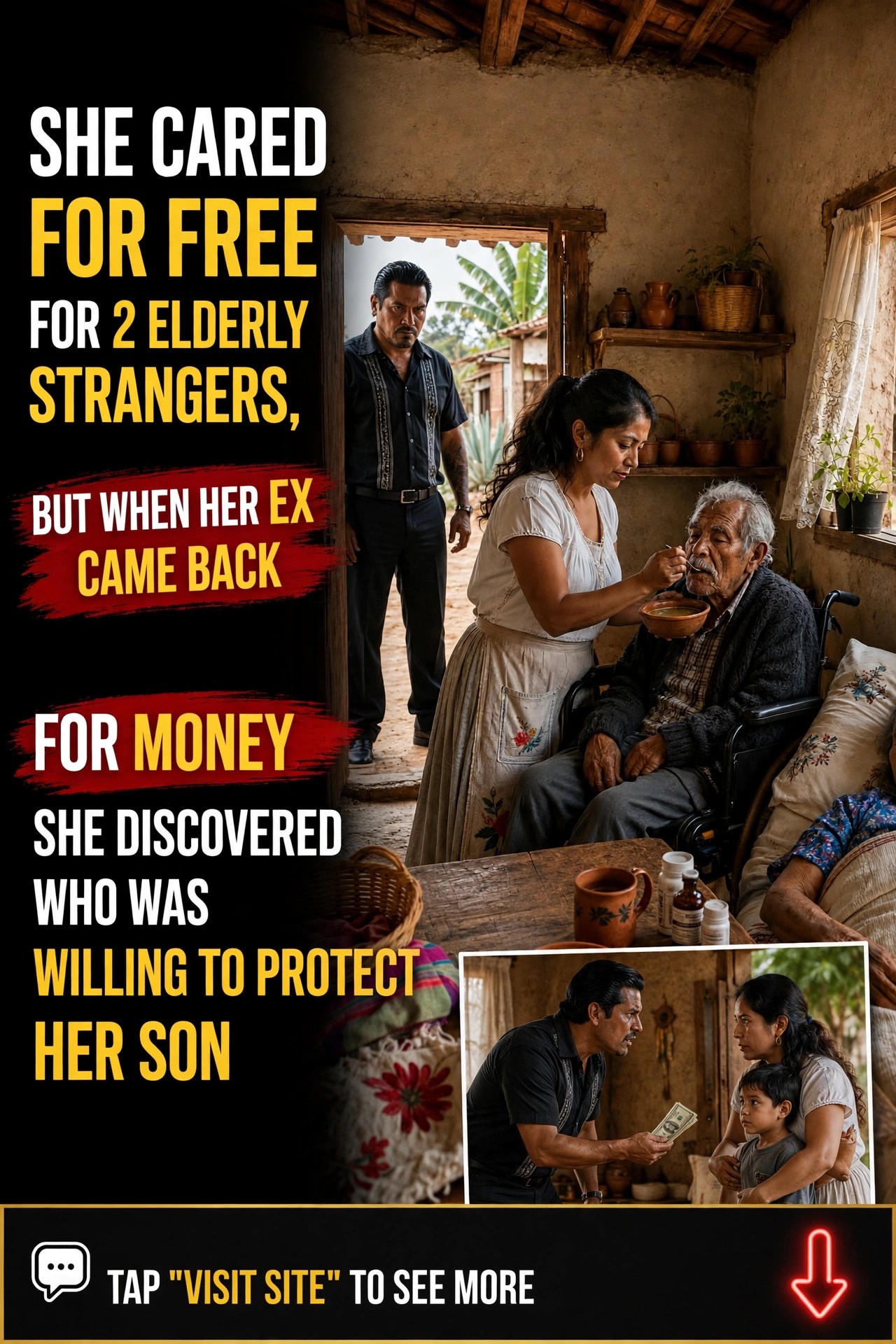
In the village of San Miguel, everyone knew Carmen Duarte’s knock. Three mornings a week she climbed the hill to the crumbling house of Don Aurelio, eighty-eight, and his wife Doña Paz, eighty-five, carrying soup, bread, and medicine she paid for with the little she earned washing clothes. The old couple’s children lived in the capital and sent excuses instead of visits. Carmen had no obligation to them — they were not family, not employers, nothing. When neighbors asked why she did it for free, she shrugged: «Because one day we will all be old, and God is watching how we treat the ones nobody sees.»
The old couple, in return, gave her the only wealth they still had: their stories, their prayers, and a place at their table where Mateo was treated like a grandson. Don Aurelio taught the boy to whistle and to name the birds; Doña Paz saved him the sweetest part of every fruit, though fruit was scarce. Carmen often arrived home tired to the bone, her hands cracked from other people’s laundry, and still she smiled — because on that hill, in that poor house, she and her son were not a burden or a charity case. They were family, and no one had ever made her feel that before.
Her own life was not easy. She was raising her son Mateo, five years old, alone, after her partner, Raúl, abandoned them for another woman and another town. So when Raúl appeared at her door one rainy evening, smelling of alcohol and desperation, Carmen’s blood ran cold. He had heard she «worked for rich old people» and demanded money — money he claimed she owed him for the years together. When she refused, he grabbed her arm, looked toward Mateo hiding behind the table, and said the words that froze her: «Then I’ll take the boy. A son should be with his father.»
What Raúl did not know was who Don Aurelio had been before time bent his back: forty years a judge, and still the most respected name in three counties. That Sunday, when Carmen arrived trembling and told them everything between tears, the old man made three phone calls from his chair. The next morning, a lawyer arrived at Carmen’s house with a custody order protecting Mateo, a formal warning that Raúl never set foot near them again, and something more: Don Aurelio and Doña Paz had signed a document naming Carmen and Mateo as heirs to their house and land. «You fed us when our own blood forgot us,» Doña Paz said, holding Carmen’s hands. «Let us feed your son’s future.»
Raúl left the village within the week and never came back; the judge’s name was a wall no coward dared climb. Carmen still climbs the hill three mornings a week, but now Mateo runs ahead of her, calling two names through the gate — «Grandpa Aurelio! Grandma Paz!» — because family, she learned, is not always the one you are born into. Sometimes it is the one that stands between you and the storm, exactly when you need it most.