

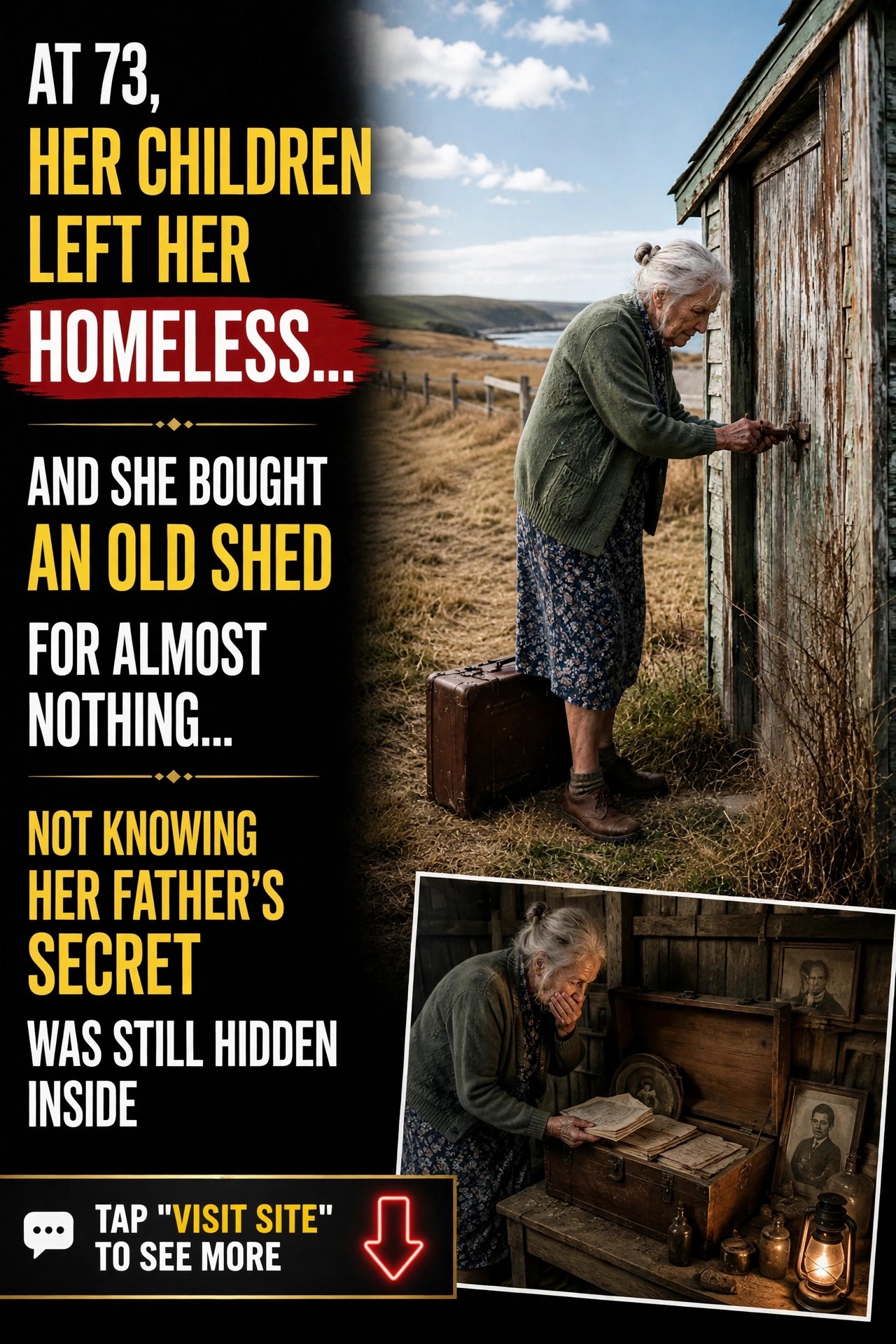
Doña Elena Márquez was seventy-three years old the day her son and daughter divided her house between them «for her own good,» sold it within a month, and left her standing at the gate with one suitcase and a plastic bag of photographs. She did not beg. She took the bus to the edge of town, to the dry fields where the wind smelled of dust, and with the few coins she had hidden in her apron she bought the one thing nobody wanted: a collapsing old storage shed with a rusted door, sold to her for almost nothing by a man who laughed as he took her money.
She swept the dirt floor, hung her photographs on the wooden wall, and made the shed her home with the dignity of a queen in a palace. It was on the third day, moving a stack of rotten planks, that she found it: an iron-bound trunk buried beneath the floorboards, its lock green with age. Elena’s hands trembled as she pried it open — because she recognized the handwriting on the bundle of letters inside before she read a single word. It was her father’s.
Don Tomás Márquez had died when Elena was twelve, and the family story said he had lost everything gambling. The letters told a different truth. Her father had been a land surveyor who discovered that the valley’s most powerful landowner had falsified the boundaries of forty small farms — including his own. The trunk held the original survey maps, notarized copies, a savings book in a bank that still existed, and a final letter addressed «to my daughter, when she is old enough to fight.» For sixty years, the shed — her father’s old survey office — had kept his secret safe, waiting. The land stolen from him, including the very fields where her children now built their houses, had legally never stopped belonging to his heirs.
Elena did not run to shout it in the plaza. She walked, slowly and straight-backed, to the office of a young lawyer in the capital, and laid sixty years of silence on his desk. The case took eleven months. The court recognized the fraud, restored the Márquez lands, and the bank returned her father’s savings with six decades of interest. Her son and daughter arrived at the shed with flowers and rehearsed tears, suddenly remembering they had a mother. Elena received them kindly, served them coffee — and told them the house she was building with her inheritance would have a room for any child who visited her out of love, but that the land would go, by her written will, to a foundation for abandoned elderly women. «Your father waited sixty years in a trunk to protect me,» she said. «I can wait the rest of my life for you to learn what he knew: a parent’s love is not a debt you collect. It is a treasure you earn.»