

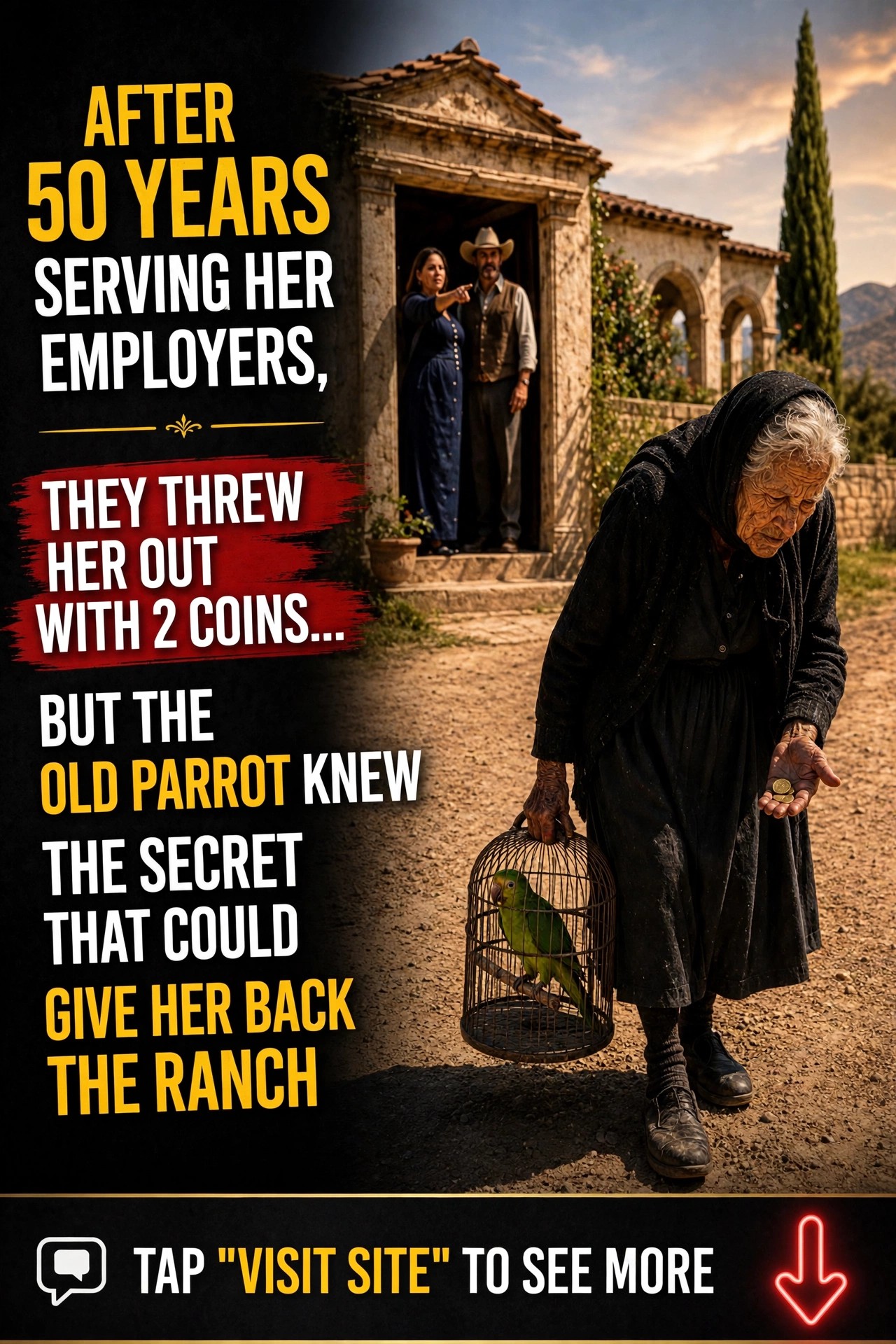
Fifty years is long enough to become part of a house, and that is what Nicasia was to the Herrera ranch: she had arrived at fourteen, barefoot, and had raised three generations — cooked their feasts, nursed their fevers, buried the old master, Don Aurelio, with her own hands washing his face for the coffin. So the morning his grandchildren, returned from the city with city appetites, told her the ranch was being sold and her services were «no longer required,» the whole town expected her to collapse. Instead she watched, dry-eyed, as the eldest grandson counted out her settlement for fifty years of life: two coins, dropped into her palm like a tip for a stranger. «And take that bird,» he added, «he’s the only one who’ll miss you.» The bird was Perico, a green parrot of forty years, who had lived outside the master’s study window since before the grandchildren were born — and who repeated, as everyone in the valley knew, absolutely everything he heard.
Nicasia walked out of the ranch with her bundle, her cage, and her two coins, and went to her niece’s house in town. And it was there, over the following days, that Perico began to say the thing. Parrots do not invent; they return. In the voice that everyone recognized with a chill — the creaking, deliberate voice of Don Aurelio himself, learned across forty years of evenings — the parrot began to repeat, at dawn, the same phrases: «Behind the saint… my true will… Nicasia is my daughter of the heart… the ranch is hers… behind the saint, in the wall…» He had been there, on his perch, through the open window, on the three nights the dying master dictated his final wishes to a lawyer friend — a friend who had died himself before he could file the document, leaving the grandchildren’s version of the will standing unopposed. Until the parrot talked.
It was the town’s young notary who heard it first, buying eggs at the market where Nicasia’s niece had carried the cage — and a notary knows the difference between a bird’s nonsense and a dead man’s legal phrasing. He followed the words the way you follow a map. Behind the image of the saint in the ranch’s chapel wall, sealed in a tin box against the damp, the authorities found it: Don Aurelio Herrera’s true, final, witnessed will. It left the ranch, the land, and the house to Nicasia Fuentes, «who served this family for fifty years and was more family to me than my own blood — let her be thrown out by no one.» The grandchildren’s lawyer read it twice and quietly put away his papers.
The grandchildren left the valley with considerably less than two coins’ worth of dignity, and Nicasia walked back into the ranch through the front gate, carrying her own cage, to the applause of every worker on the place. She did one thing more, which the town retells with delight: she sent for the eldest grandson before he left, and into his palm she placed two coins. «For your journey,» she said, without a drop of cruelty. «Now you know what they weigh.» Perico lived out his days in the ranch kitchen, fat on sunflower seeds, still greeting each dawn in the old master’s voice — and if you ask Nicasia, now mistress of the house, who really owned the ranch all those years, she points at the cage and smiles: «Him. He was just waiting for someone to listen.»