

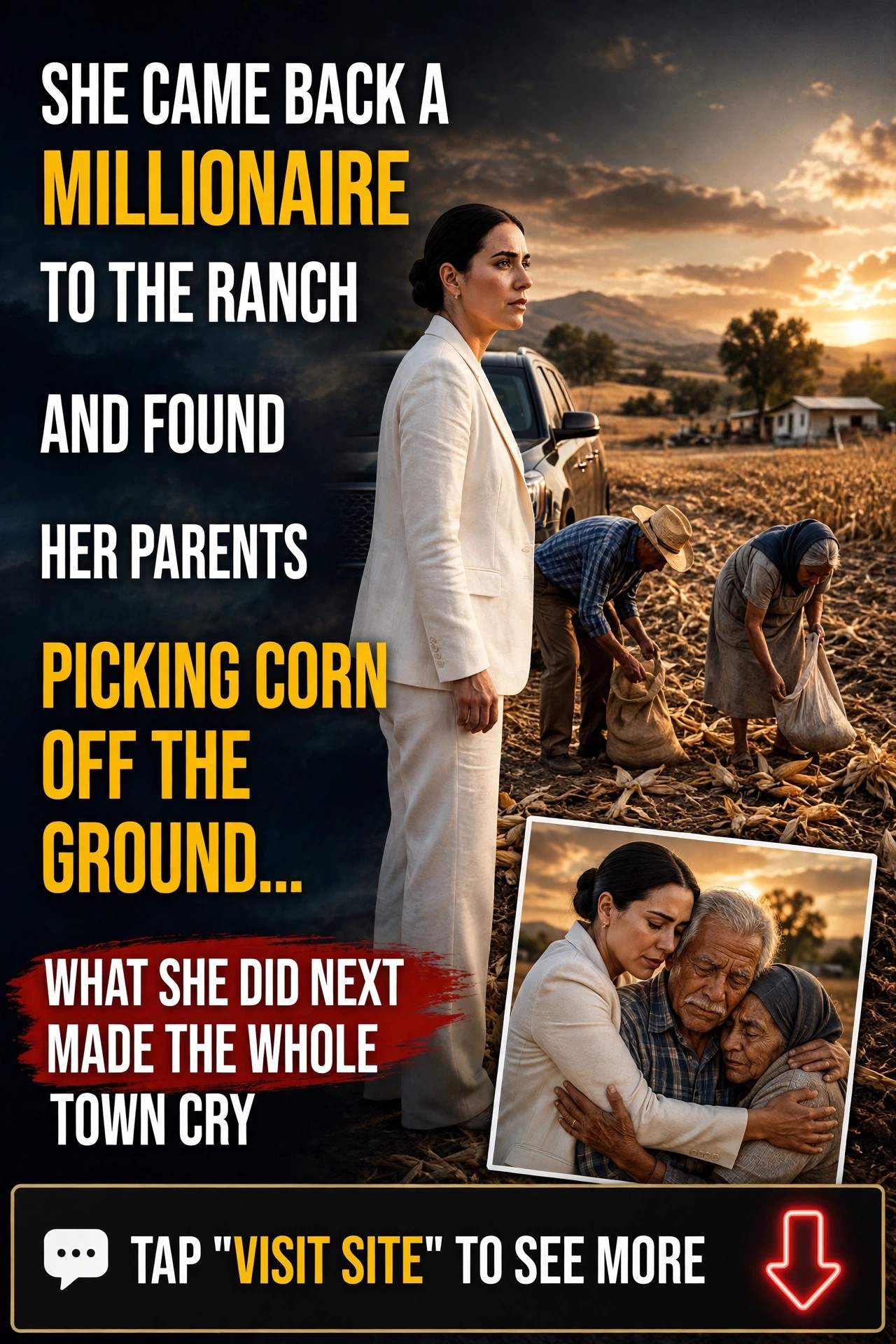
Mariana Solís left the ranch at seventeen with her shoes held together by wire and a promise whispered to her parents at the gate: «I will come back for you.» The city was not kind, but she was relentless — cleaning offices at night, studying accounting by dawn, sleeping four hours and dreaming in two languages. Twenty years later she returned as the owner of a logistics company, in a white suit and a black SUV, with a fortune that had made business magazines in the capital print her photograph. She drove the last miles with her heart in her throat, imagining her parents on the porch of the little house, older, waiting, proud.
The house was empty, its door hanging open. A neighbor, gone pale at the sight of her, pointed toward the harvested cornfield of Don Aurelio, the landowner. Mariana walked between the dry stalks in her white suit and stopped, unable to breathe. There, in the late sun, her parents — Don Manuel, seventy-nine, and Doña Teresa, seventy-six — moved slowly on their knees between the rows, gathering, kernel by kernel and ear by ear, the fallen corn the harvesters had left behind. Gleaning: the ancient right of the poorest, paid in permission and humiliation. Her father filled a sack so they could sell it for a few coins and eat that week. They had told her in their letters that they were «fine, daughter, don’t worry.» They had been fine the way the poor are fine: silently, so their children can fly.
Mariana did not shout their names. She took off her jacket, knelt in the dirt between the rows in her white suit, and began gathering corn beside them, the way she had as a little girl — and only when her father looked up, confused at the stranger helping him, did she say, through tears, «It’s me, Papá. I came back for you, like I promised.» The three of them held each other in the middle of that field for a long time, while the other gleaners — the poorest families of the town, grandparents and widows with their sacks — watched and wiped their eyes.
But what Mariana did next is why the town still tells the story. She did not simply take her parents away. She bought Don Aurelio’s entire estate — the field, the land, the big house — at full price, that same week, and turned it into a cooperative in her parents’ names, where every gleaner family received land to work as owners, not beggars; where the first harvest’s profits built a school kitchen so no child in the village would study hungry; and where her parents, restored to the big house’s porch as its honored owners, received every neighbor who came to thank her with the same gentle embarrassment. «We only picked up corn,» Doña Teresa would say. And Mariana, holding her mother’s rough hands, always answered the same: «No, Mamá. You picked up everything this family ever was — dignity, patience, love — from the ground, kernel by kernel, so that one day I could find it. I just came back to carry it with you.»