

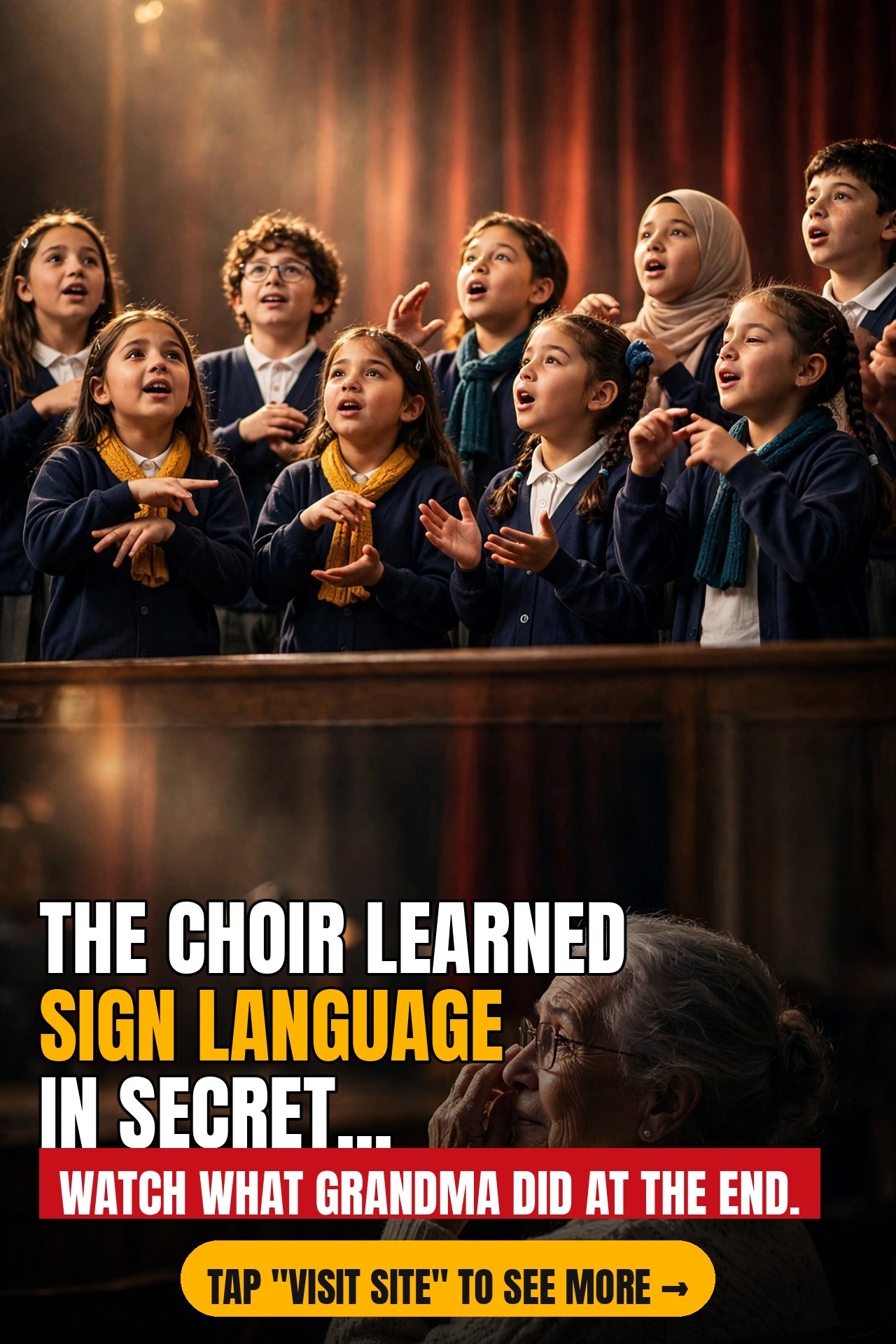
Mia Torres, twelve years old, had the strongest voice in the Riverside school choir, and one quiet sorrow: her grandmother Rosa, deaf since childhood, had never heard a single note of it. Rosa came to every concert anyway. She sat in the front row, watched her granddaughter’s face, clapped when the others clapped, and afterward always signed the same thing: «I could see you were beautiful.»
In September, Mia’s choir teacher, Mrs. Bell, announced the Christmas concert. That same week, Mia stayed after rehearsal and asked a question that changed everything: «Could we sign one song? Just one — so my grandma can have it too?»
Mrs. Bell did not say yes right away. She said something better: «Let’s not do one song. Let’s do the whole finale — and let’s not tell her. Let’s make it a surprise.»
For three months, thirty-four children stayed late twice a week, learning sign language from a volunteer interpreter. It was hard. Small hands tangled, signs were forgotten, and more than once someone cried with frustration. But every time they wanted to quit, Mia told them about the front row, and the grandmother who clapped when the others clapped, and they stayed.
On the night of the concert, the hall was full. Rosa sat in her usual seat, front row, center. The choir sang the program beautifully. Then the lights softened, the piano played the first chords of the finale — and thirty-four children raised their hands and began to sing and sign at the same time, every word, in perfect unison.
Rosa’s hands flew to her mouth. For the first time in her life, a song was reaching her whole. She could follow every word of her granddaughter’s solo, signed by thirty-four children who had given up their afternoons for a woman most of them had never met.
When the last note ended, Rosa stood up — and she did something no one expected. She raised her hands and signed, slowly and clearly, so the whole hall could see: «That was the most beautiful song I have ever heard.» The interpreter spoke the words aloud into the silence, and eight hundred people stood up at once.
Mia ran off the stage and into her grandmother’s arms. And every Christmas since, the Riverside choir signs its finale — because, as Mrs. Bell tells each new class, some audiences you sing for with your voice, and some you sing for with your hands.