

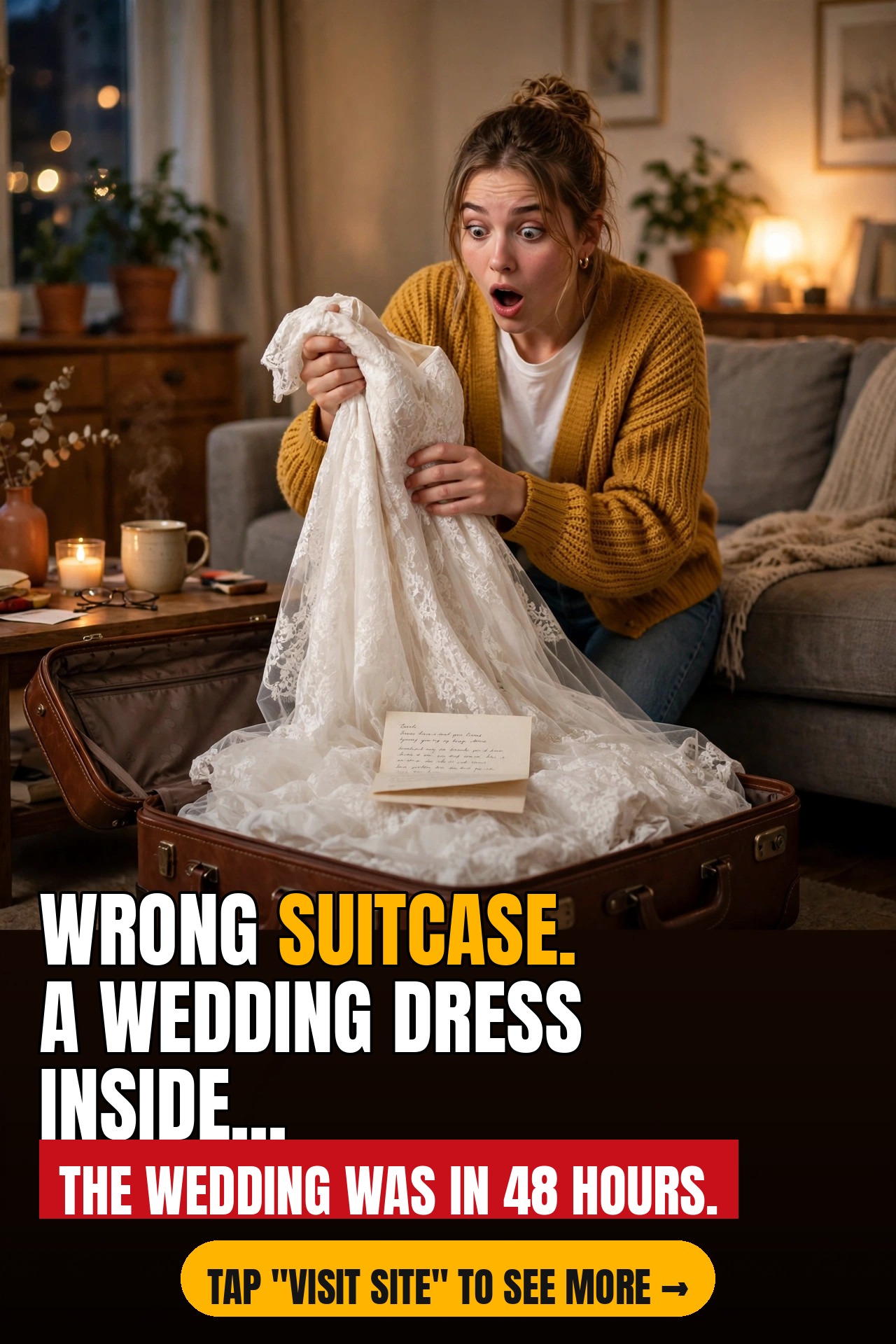
Maya Chen had flown across the country for a job interview, and all she wanted was her suitcase, a hot shower, and a good night’s sleep. The airline, however, had other plans. The bag that rolled toward her on the carousel was the same dark blue, the same size, and had a tag with her name on it — but when she opened it in her hotel room, she found no clothes of hers at all. Instead, folded with impossible care, there was a wedding dress. White silk, lace at the sleeves, a pair of satin shoes tucked beside it — and on top, a sealed envelope with a name written in flowing script: “For Sofia, on your wedding day.”
Maya stared at the dress for a long time. Somewhere out there, a bride named Sofia was opening Maya’s suitcase — full of interview clothes and a lucky blazer — and panicking. And somewhere out there, the wedding was happening this weekend. Maya picked up the envelope. It was not hers to open. But the airline’s lost-luggage line told her the other suitcase had already been delivered to an address across town, and that her own bag would be returned “within three to five business days.” Three to five business days was too late for a Saturday wedding. Maya looked at the dress, looked at the envelope, and made a decision: she was going to find Sofia herself.
It took four phone calls, two taxi rides, and one very patient hotel concierge to track the bride down. Sofia Alvarez was getting married on Saturday at a garden venue forty miles away, and her dress — her grandmother’s dress, altered to fit her — had been in that suitcase. Maya’s own suitcase, meanwhile, was sitting in Sofia’s apartment, untouched. “I thought the airline would fix it,” Sofia said over the phone, her voice breaking. “But they said the same thing — three to five days. My grandmother wore this dress in 1962. I can’t get married without it.”
Maya did not wait for the airline. She packed the dress back into the suitcase with the same care she had found it in, tucked the envelope on top, and drove forty miles through Friday traffic to Sofia’s apartment, where the two women swapped suitcases on the doorstep like spies exchanging briefcases. Sofia opened the case, saw the white silk, and burst into tears. “And the letter,” Maya said, holding it out. “It was on top. I didn’t open it. But I think it matters.” Sofia took the envelope with shaking hands — and that was when Maya learned what the letter was.
It was from Sofia’s grandmother, written the week before she died, and meant to be read aloud at the wedding. In it, she wrote about wearing that same dress in 1962, about the nervous morning of her own wedding day, and about the secret she had kept for sixty years: that she had almost not gone through with it, until her mother told her that love was not the absence of fear, but the decision to walk forward anyway. “Wear the dress, my darling,” the letter ended, “and when you feel afraid, remember — I was afraid too, and I have never once regretted walking down that aisle.”
On Saturday, Maya cancelled her interview — she had already decided the job was not worth a weekend of regret — and drove to the garden venue in her lucky blazer, sitting in the back row as a guest of honor. She watched Sofia walk down the aisle in her grandmother’s dress, glowing, and she watched Sofia’s father read the letter aloud, his voice cracking, while the whole garden wept. After the ceremony, Sofia found Maya by the fountain, hugged her hard, and said, “You saved my wedding. You saved my grandmother’s words.”
Maya flew home on Sunday with her own suitcase, her interview rescheduled, and a new friend who calls her every month. She still thinks about that wrong suitcase — how the airline’s mistake put a wedding dress in her hands, and how a letter that had to arrive that weekend arrived because a stranger decided it mattered more than her own plans. Some deliveries, she learned, are not made by airlines at all. They are made by people who stop, look at what is in front of them, and choose to carry it the rest of the way home.