

It started with a notice pinned to the library door at Oakwood Elementary: “Due to budget cuts, the library will close at the end of the term.” Mrs. Delgado, the librarian, read it out loud to her class with a brave smile, but the kids could see her hands shaking. The library was where Noah did his homework, where Lily found the books about space that made her want to be an astronaut, where Marcus hid during lunch to read comics, and where Zoe had learned to love stories in the first place. Three hundred dollars — that was all the library needed for new books to stay open. To four ten-year-olds, three hundred dollars sounded like a million.
“We can raise it,” Noah said at lunch, with the confidence only a ten-year-old can have. “My grandma says lemonade stands make tons of money.” And so, on Monday afternoon, four kids set up a wobbly card table on the corner of Maple and Third, with a hand-painted sign that read “LEMONADE — 50¢ — SAVE OUR LIBRARY,” a pitcher of lemonade, and a jar labeled “FOR NEW BOOKS.” Their first customer was the mailman, who bought two cups and dropped a dollar in the jar. Their second was Mrs. Delgado herself, who cried a little and bought a cup for every teacher in the school.
By Tuesday, word had spread. The kids had made eleven dollars. By Wednesday, it was forty — and a local bakery donated cookies to sell beside the lemonade. On Thursday, a reporter from the town paper stopped by, took a photograph of four kids in aprons counting coins, and wrote a story that ran on the front page the next morning: “Four Kids, One Lemonade Stand, and a Library Worth Saving.”
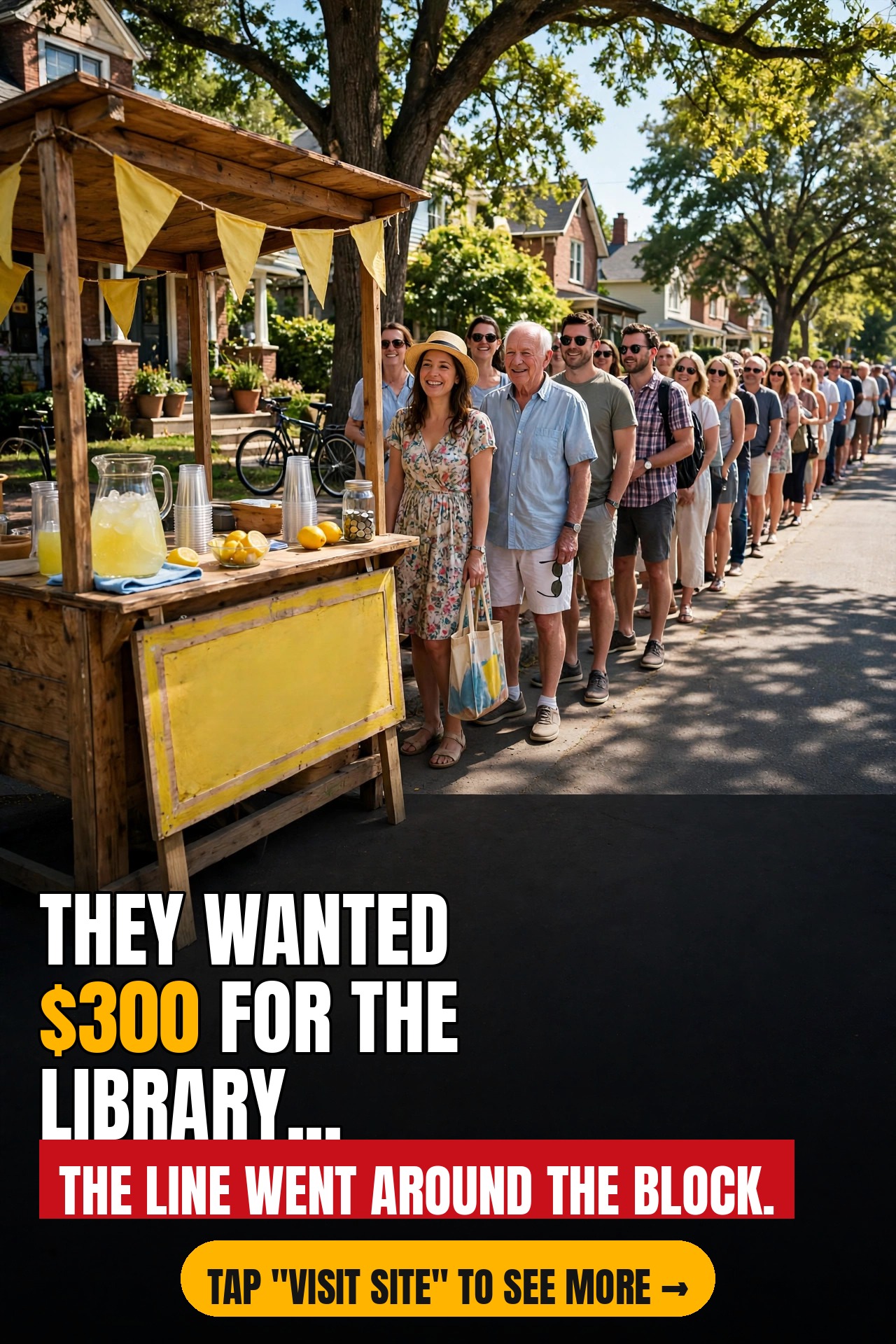
And then came Friday. Noah arrived at the corner at eight in the morning and stopped dead. There was a line. A real line — stretching down the block, around the corner, and halfway down the next street. There were parents with toddlers, teenagers on bikes, a fire truck crew in uniform, and cars with license plates from other towns, their drivers holding empty cups out the window. Somebody had shared the newspaper story online overnight, and strangers were driving in from everywhere, just to buy lemonade from four kids trying to save a library.
The kids ran out of lemonade by ten o’clock, so the bakery brought more lemons, the grocery store donated sugar, and a neighbor wheeled over a second table. By noon, the jar was so full they had to start a second one. People weren’t just buying lemonade anymore — they were dropping in five-dollar bills, twenties, and folded notes that said “For the library” and “For the kids who care.” One old man pressed a hundred dollars into Lily’s hand and said, “I learned to read in a library like yours. Don’t you dare let it close.”
When the sun went down on Friday, the four kids sat on the curb, sticky and exhausted, and counted the money with Mrs. Delgado. One thousand two hundred and forty-seven dollars. Four times what they needed. They stared at the piles of coins and bills in silence, and then Zoe started laughing, and then they were all laughing, and then Mrs. Delgado was hugging them so hard they could barely breathe.
The library did not close. With the money the kids raised, Mrs. Delgado bought new books — and with the story of the lemonade stand, the town council quietly found the funding to keep the library open for good. Today, there is a photograph hanging on the library wall: four kids behind a card table, grinning, with a line stretching around the block behind them. And every year, on the first Friday of spring, the kids — a little taller now — set up the same wobbly table on the same corner, pour the same lemonade, and raise money for new books. Because they learned something that week that no textbook could have taught them: a library is not a room full of books. It is a promise — and sometimes, all it takes to keep a promise is four kids, a pitcher of lemonade, and a town that shows up.