

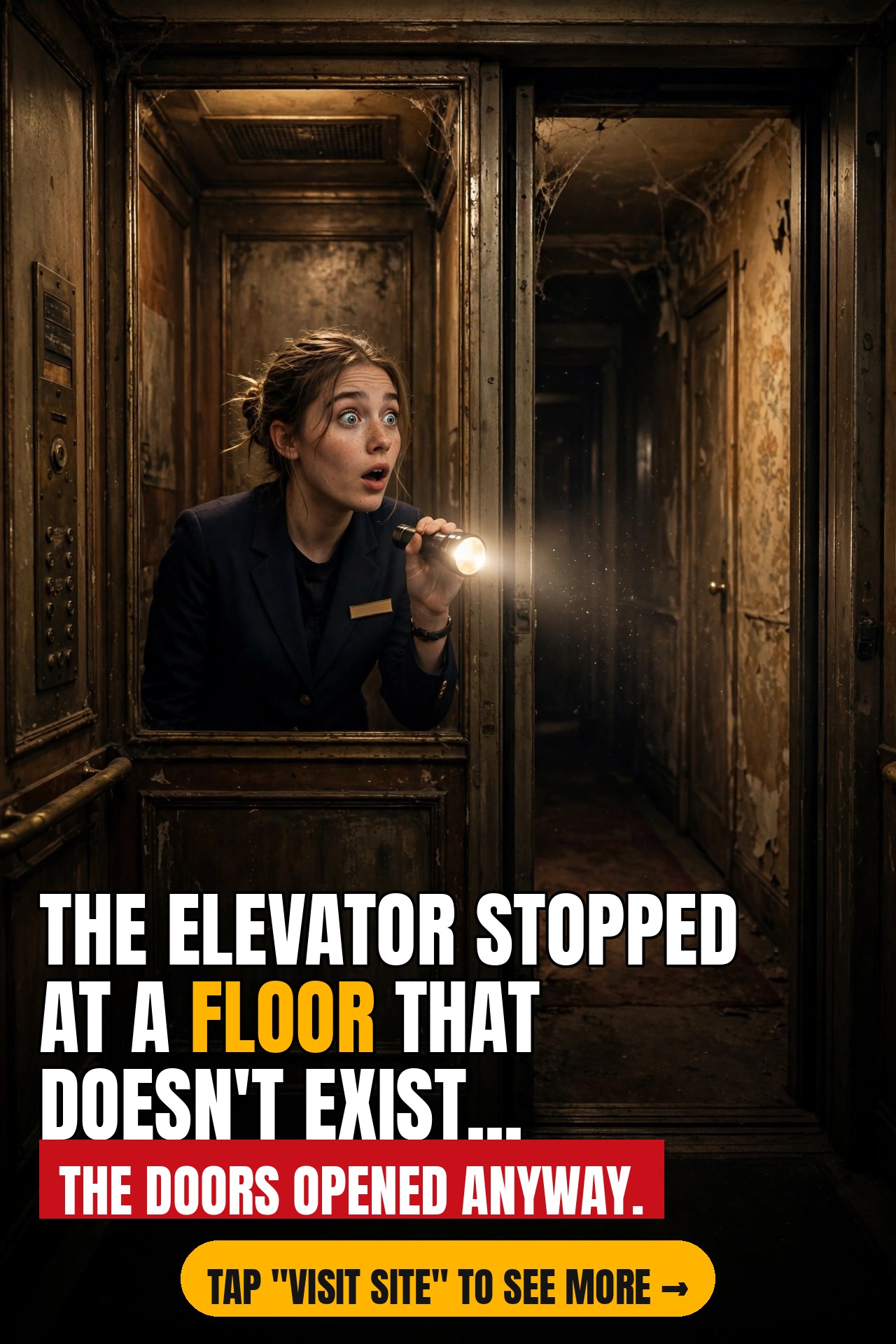
Mara Ellison had worked the night shift at the Grand Mercer Hotel for three years, and in all that time she had learned to ignore most of the old building’s noises: the sigh of the radiators, the groan of the pipes, the soft ticking of the lobby clock. But she could not ignore the elevator. Every night, without fail, car number two would rise past the twelfth floor, hesitate, and stop — not at the roof, not at any floor at all, but somewhere in between, where the indicator light flickered and died. The doors never opened. The car simply waited in the dark, as if it were listening, and then, after a long minute, it would sink back down to the lobby, empty.
The day staff laughed it off. “Old wiring,” the maintenance chief said, tapping the panel with a wrench. “A faulty sensor. It happens in buildings this age.” But Mara had checked the blueprints herself, late one quiet night, spreading the yellowed sheets across the front desk. The Grand Mercer had twelve guest floors and a roof. There was no thirteenth floor, no mezzanine, no service level between them. On paper, the place where the elevator stopped did not exist.
Still, the guests noticed. A businessman from Chicago swore the car had paused and that he had heard music — a piano, faint and far away, playing something slow and old-fashioned. A honeymoon couple reported the smell of cigar smoke and gardenias in the empty car. Mara logged every incident in a notebook she kept in the desk drawer, and the pattern only grew stranger: the elevator always stopped at 11:47 p.m., always for exactly ninety seconds, and always when it was empty.
On the first Friday of November, the hotel was full for a wedding, and Mara was alone at the desk when the familiar chime sounded. Car number two rose, passed twelve, and stopped. Mara watched the indicator go dark. She told herself to stay put. She had told herself that a hundred times before. But that night, something was different: instead of silence, she heard the soft ding of the doors opening somewhere above her, and then, very clearly, a woman’s voice saying, “Oh, thank goodness — someone finally came.”
Mara took the stairs. She told herself she was only checking for a stuck guest, only doing her job, but her heart was beating so hard she could hear it in her ears. On the landing between the twelfth floor and the roof, where there should have been nothing but a blank wall and a locked service door, there was a corridor. Warm light spilled from it, and the air smelled of gardenias. At the end of the corridor stood a ballroom Mara had never seen — chandeliers blazing, a piano playing by itself, and a woman in a silver 1920s evening dress standing beside the open elevator, holding a small suitcase.
“I’m sorry,” the woman said, her voice trembling with relief. “My name is Clara Whitfield. I checked in for the New Year’s ball in 1927, and the elevator brought me here, and then — then it never came back for me. I’ve been waiting for someone to notice the floor was still here.” Mara stared at her. The woman’s dress was dusty, her shoes scuffed, but her eyes were clear and very much alive. Behind her, the ballroom was full of people in evening clothes, laughing and dancing, frozen in a single moment that had never been allowed to end.
Mara did the only thing she could think of: she held out her hand and said, “Then let’s go down together.” Clara hesitated, looking back at the dancers, and then she took Mara’s hand. They stepped into the elevator, and as the doors closed, the music swelled once — a final, joyful chord — and then faded into silence. The car descended smoothly, past twelve, past eleven, all the way to the lobby, where the wedding guests were dancing under the chandeliers, unaware that anything extraordinary had happened at all.
Clara set her suitcase down, looked around the bright modern lobby, and laughed — a real, startled laugh. “Ninety-nine years,” she whispered. “I waited ninety-nine years for someone to open that door.” She asked Mara to do one thing for her: to write her name in the hotel register, so that the Grand Mercer would finally know she had checked out. Mara did, in her best handwriting, and when she looked up, Clara was gone — but the lobby smelled faintly of gardenias, and on the front desk lay a single silver dance card, dated December 31, 1927, with one name written on it in elegant script: Mara.
The elevator has never stopped between the twelfth floor and the roof again. The maintenance chief calls it a miracle of rewiring, and Mara lets him. But every night at 11:47, she still glances up at the indicator, and sometimes — just sometimes — she hears a piano playing somewhere far above the roof, and she smiles. Some doors only open when someone is finally willing to climb the stairs and knock. And some guests, it turns out, were never lost at all. They were only waiting to be found.