

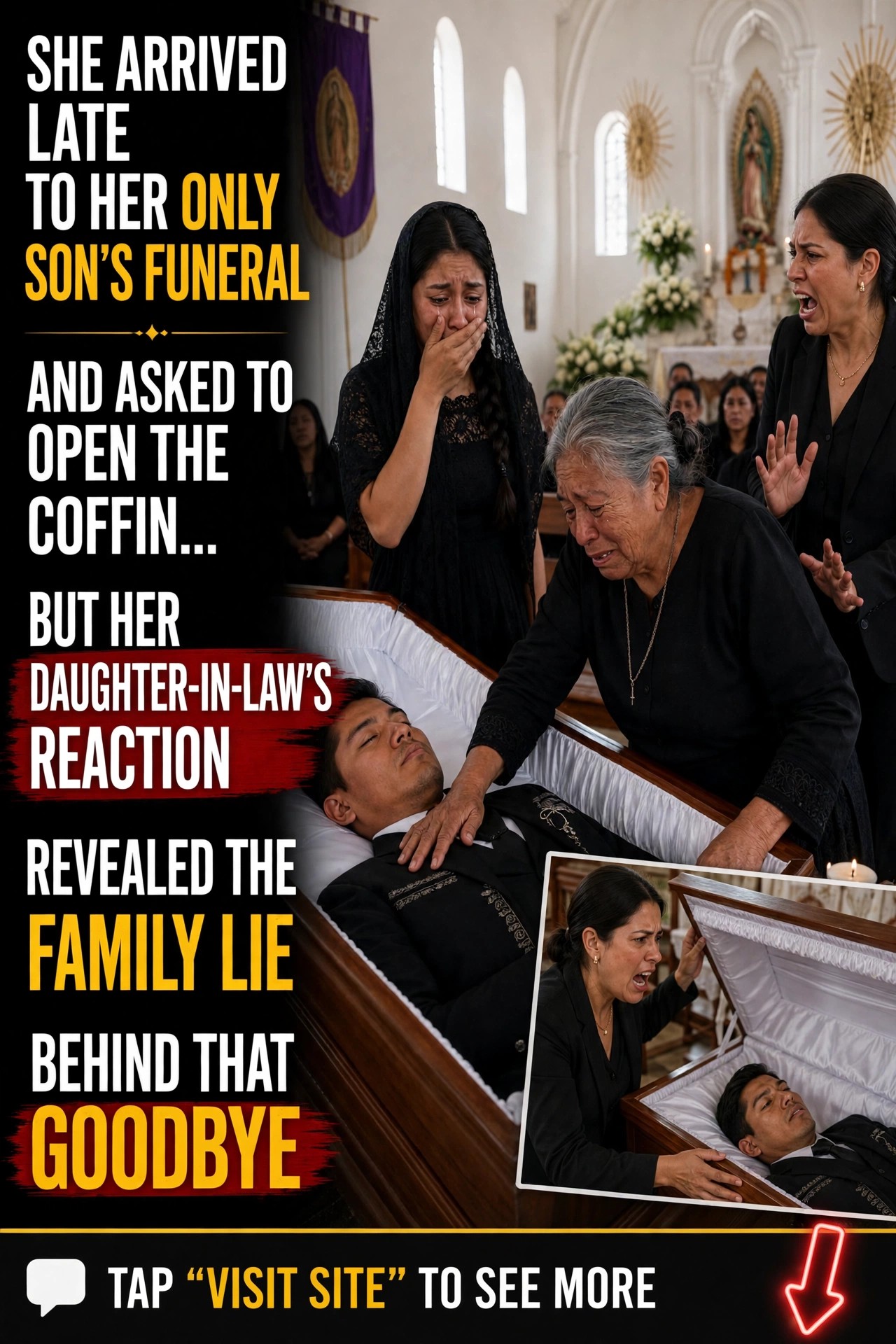
The church bells had already rung when Doña Rosa entered her only son’s funeral, leaning on her cane, dressed in black from head to toe. Her son Tomás, thirty-four years old, had died — according to his wife, Paola — in a car accident three days earlier on the highway to the capital, and the funeral home had recommended a closed coffin «because of the state of the body.» Rosa had accepted it on the phone. But a mother’s heart is an instrument no lie can tune: all night she had dreamed of Tomás as a boy, laughing, calling her from the river, very much alive — and she had woken with one certainty burning in her chest. She had not seen her son. She would not bury a closed box on someone else’s word.
So she walked down the central aisle, past the wreaths and the whispers, laid her hand on the coffin lid, and said in a voice that filled the church: «Open it. A mother has the right to say goodbye to her son’s face.» It was Paola’s reaction that froze the blood of everyone present. The widow — who until that moment had wept with perfect, inconsolable grief — turned the color of wax, threw herself across the coffin, and screamed that no one would open it, that it was her decision, that the old woman was mad with pain. Two brothers-in-law had to hold her. And in that scream, the whole town heard what no one had dared to suspect: it was not grief. It was terror.
The priest, a man who had buried three generations of that family, quietly ordered the coffin opened. Inside there was no body. There were sacks of sand, a folded suit — and an envelope taped to the lid with Paola’s handwriting: instructions to the funeral home, and a receipt for a life insurance policy of half a million, already claimed. Tomás was not dead. He was, at that very moment, in a beach hotel two states away, waiting for his wife to collect the insurance and join him to start a new life with new names — a plan that required only one thing: that an old woman bury a box without looking inside.
The police found him in three days; a man who fakes his death discovers that paperwork is immortal even when he is not. The fraud trial filled the same church with journalists instead of mourners. Paola and Tomás both went to prison, and Rosa, who visits neither, keeps in her house a photograph of her son at seven years old, by the river. «I did bury a son that day,» she tells those who ask, with a serenity that breaks the heart. «Not the one from the coffin. The one I thought I had raised. And a mother survives even that — because I opened the coffin, and I would open it again a thousand times. The truth hurts once. A lie hurts every day.»