

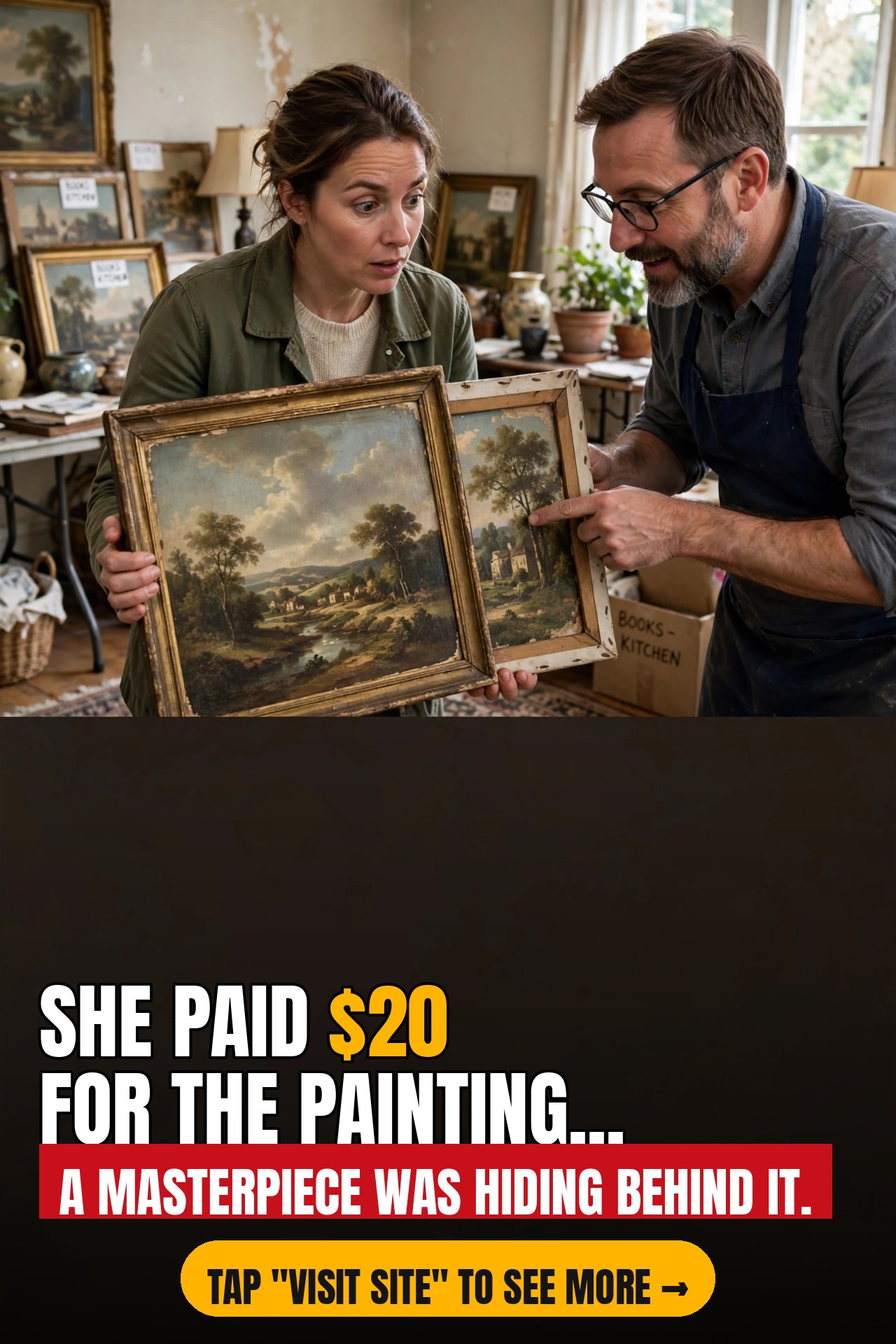
Laura Bennett bought the painting because the frame matched her hallway. That was the whole reason — the gold frame, chipped at one corner, was exactly the shade of her front hall, and the painting inside it was a dull little landscape of a field that nobody would ever look at twice. Twenty dollars at an estate sale on a rainy Saturday, and she carried it home under her arm feeling pleased with herself. It would do, she thought, until she found something better.
Three months later, the frame’s gold leaf began to flake, so Laura took the painting to a restorer named Mr. Okafor, a quiet man with forty years of careful hands. She expected him to reglue the frame and send her on her way. Instead, he called her back two days later, and his voice shook so badly she could barely understand him. “Mrs. Bennett,” he said, “you need to come to my shop. Now. And please — do not tell anyone what I am about to show you.”
When Laura arrived, Mr. Okafor had the painting laid flat on his workbench, the landscape lifted away from its stretcher like a lid. Behind it, hidden for who knew how long, was a second canvas — and on it, a portrait so beautiful it stopped Laura’s breath. A young woman in a blue dress sat beside a window, sunlight on her face, her smile so alive that Laura felt the woman might turn and speak. The paint was old, the canvas was cracked at the edges, but the skill in every brushstroke was unmistakable. This was not a hobby painting. This was a masterpiece.
“It was hidden on purpose,” Mr. Okafor said, his hands trembling as he pointed to the back of the portrait. There, in faded ink, was a name and a date: “Elena, 1912.” And beneath it, a second line: “Hide her until it is safe.” Laura’s mind raced. The estate sale had been for the house of an old woman named Elena Marsh, who had died at ninety-eight. The family had sold everything, never knowing what was in the walls — or behind the paintings.
Mr. Okafor did some digging, and what he found made the story even more extraordinary. Elena Marsh had been a painter herself, and the portrait was of her mother, painted by a young artist who later became famous — a man whose early works were thought to have been destroyed in a fire during the First World War. This one had survived because someone — Elena, or her mother — had hidden it behind a dull little landscape, where no thief, no soldier, and no fire would ever think to look. For over a hundred years, a masterpiece had been hanging in plain sight, pretending to be nothing at all.
Laura could have sold it. The offers, when the news quietly spread, were enormous — enough to change her life several times over. But she kept thinking about the name on the back, and the woman in the blue dress, and the family who had sold the painting for twenty dollars without knowing what they were giving away. So Laura did something nobody expected: she invited Elena Marsh’s grandchildren to Mr. Okafor’s shop, lifted the landscape aside, and showed them their great-grandmother’s face for the first time.
There were tears, and then laughter, and then a long silence while they simply looked. The family donated the portrait to the city museum, where it now hangs in a sunlit room — the woman in the blue dress, smiling at everyone who passes. And in Laura’s hallway, in the gold frame that started it all, hangs a small print of the portrait, with a note underneath in Laura’s handwriting: “Some treasures hide in plain sight. All it takes is someone willing to look behind the canvas.” She still thinks twenty dollars was the best money she ever spent — not for what she bought, but for what it taught her to find.