

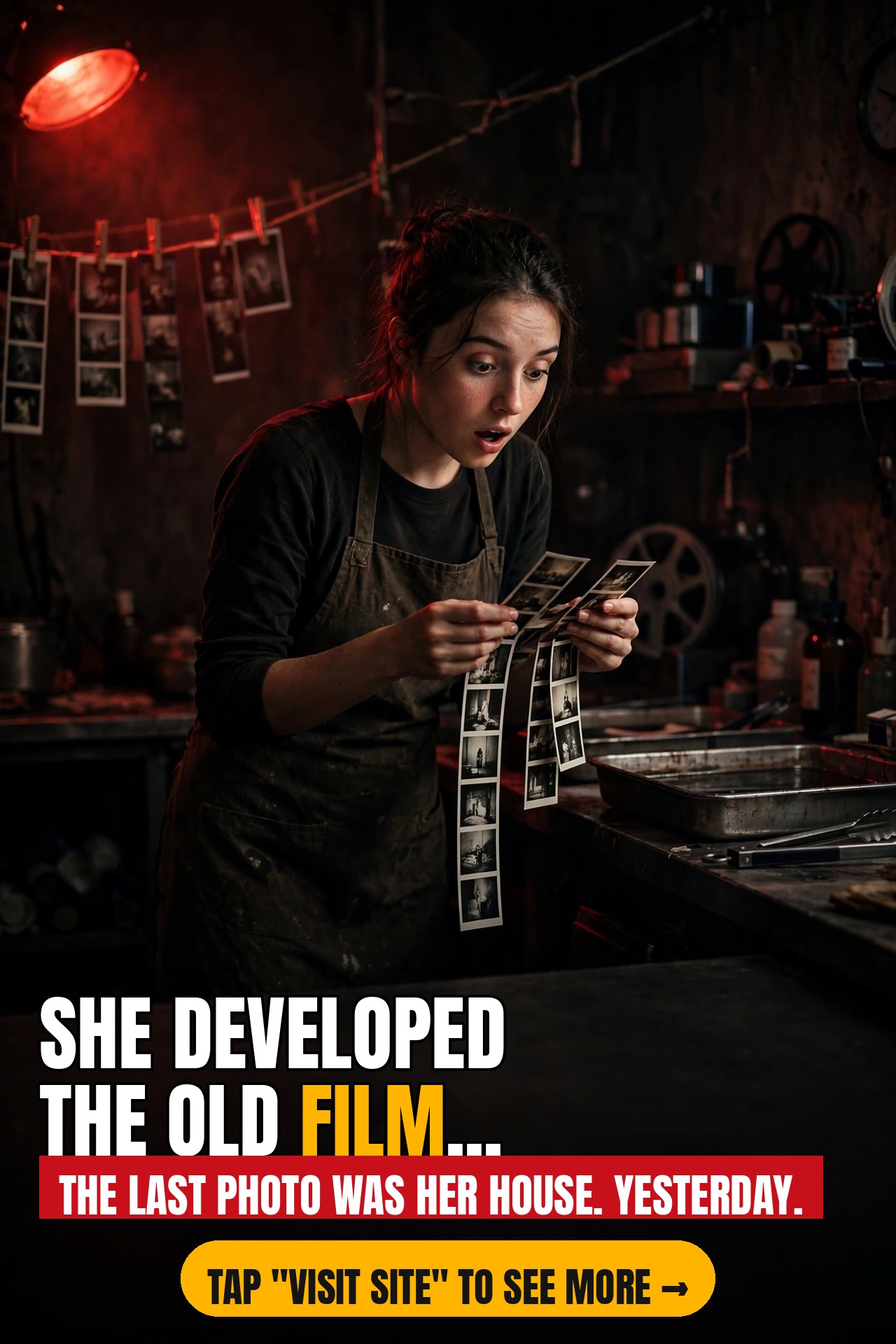
Hannah Reyes bought the camera for five dollars at a thrift store on a rainy Saturday, mostly because it was beautiful: a heavy old film camera with a leather case, a lens that still turned smoothly, and a little dent on one corner that made it feel loved. The clerk warned her that it probably did not work. Hannah did not care. She took it home, opened the back — and found a roll of film still inside, wound tight, waiting. She had no idea if it was ten years old or forty. She took it to the last photo lab in town and asked them to develop it, just to see.
A week later, the lab called. Hannah picked up the envelope with shaking hands and spread the prints across her kitchen table, one by one. A birthday party, judging by the clothes, sometime in the seventies. A wedding in a small church. A dog asleep in a patch of sun. A baby in a yellow blanket. A family picnic, a Christmas tree, a young couple laughing on a porch. Whoever had owned this camera had used it to hold on to a whole life — and then, for some reason, they had put the camera down, forgotten the film inside, and let it all go to a thrift store.
And then Hannah turned over the last photograph, and her heart stopped. It showed her own street. Her own house. Her blue front door, her garden, the oak tree in her yard — and on the porch, yesterday’s newspaper, the date clearly visible on the front page. Yesterday. The film was supposed to be decades old. The clothes in the photos were decades old. But the last frame had been taken yesterday, of her house, by someone standing right where she was standing now.
Hannah did what anyone would do: she locked her doors, checked her windows, and barely slept. The next morning, she took the photograph to the thrift store and asked the clerk who had donated the camera. The clerk remembered — an elderly man, tall and thin, who had come in the day before Hannah bought it, carrying the camera like it was made of glass. “He said it was time,” the clerk said. “He said the camera had done its job.” The clerk gave Hannah an address. It was two streets away. It was her own street.
Hannah walked to the address with the photograph in her hand, and an eighty-four-year-old man named Walter opened the door. He looked at the photograph, and then at Hannah, and he smiled — a slow, relieved smile. “You found it,” he said. “I was hoping someone would develop that roll.” Walter had owned the camera since 1974. For fifty years, he had photographed his neighborhood: every wedding, every baby, every Christmas, every ordinary Tuesday worth remembering. And yesterday morning, before he gave the camera away, he had taken one last photograph — of Hannah’s house, because she had just painted her front door blue, and planted a garden, and made the street beautiful again, and he wanted to remember it that way.
Walter invited her in, and Hannah spent the whole afternoon looking through his albums — fifty years of her street, her neighbors, her house before she ever lived in it. There was her house in 1982, with a different family on the porch. There was the oak tree when it was barely taller than a person. And there, on the last page of the last album, was a space left empty, with a caption written underneath in shaky handwriting: “For whoever develops the roll — the story continues with you.”
Hannah printed the last photograph, framed it, and gave it to Walter — and then she did something else: she bought a roll of film, loaded the old camera, and took her first photograph with it, of Walter standing in his doorway, smiling. She still uses that camera. Every month, she develops a roll, and every month she brings Walter the prints. The camera that cost five dollars turned out to be priceless — not because of the film inside it, but because of the man who had spent fifty years looking through its lens, and who had been waiting, all that time, for someone to look back.